Volume 2
First-[second] report of the Royal Sanitary Commission.
- Great Britain. Royal Sanitary Commission
- Date:
- 1869-1874
Licence: Public Domain Mark
Credit: First-[second] report of the Royal Sanitary Commission. Source: Wellcome Collection.
Provider: This material has been provided by London School of Hygiene & Tropical Medicine Library & Archives Service. The original may be consulted at London School of Hygiene & Tropical Medicine Library & Archives Service.
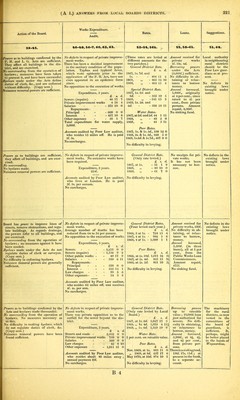
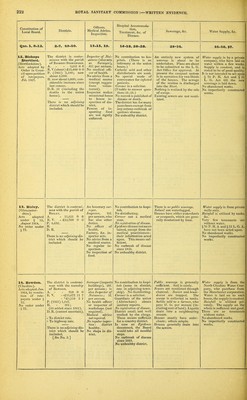
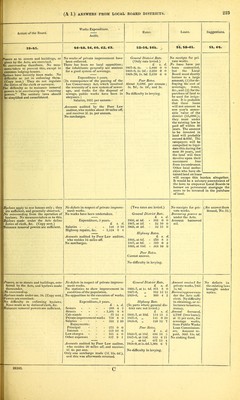
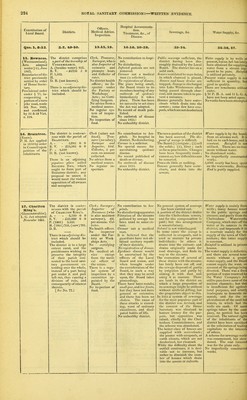
245/418 (page 225)
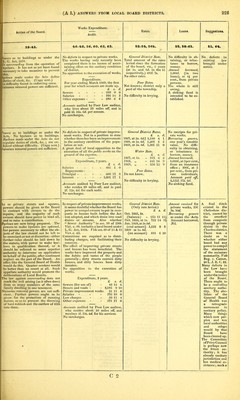
![Action of the Board, Works Expenditure. Audit. Rates. Loam. Suggestioni. 39-45. 46-4:8, 56, 60, 62, 63. 52-54, 56k. 55, 58-61. 51, 64. 'nwers as to buildings as under the L. G. Act, 1858. ,V< overcrowding from the operation of byelaws. It has not as yet been found necessary to take measures to prevent this. hjdaws made under the Acts define duties of clerk, &c. (Copy sent.) lo difficulty found in enforcing same, aiisance removal povfers are sufficient. No defects in respect to private works. The works having only recently been completed there is no means of ascer- taining effect on the sanitary condition of district. No opposition to the execution of works. Expenditure. For year ending Blarch 1869, the first year for which accounts arc made up. £ s. d. Sewers - - - - 299 0 0 Salaries - - - - 103 14 2 Other expenses - - - 280 6 8 Accounts audited by Poor Law auditor, who lives about 20 miles off, and is paid 2Z. 12s. Qd. per annum. No surcharges. General District Rate. Total amount of the rates levied since the formation of the board, viz., 2 years (at Is. and 8d. in the \l. respectively,) 493^. 7s. No other rates. Poor Rates. Not known ; district only a part of-the township. No difficulty in levying. No difficulty in ob- taining, or reluc- tance to borrow, money. Amount borrowed, l.OOOZ. (in two loans), at 4^ per cent., from private persons. The whole is still owing. A sinking fund is intended to be es- tablished. 'owers as to buildings as under the Acts. No byelaws as to buildings. Byelaws made under the Acts do not regulate duties of clerk, &c. ; are en- ! forced without difficulty. (Copy sent.) fuisance removal powers are sufficient. No defects in respect of private improve- ment works. Not in a position to state whether there has been an improvement in the sanitary condition of the popu- lation or not. A great deal of local opposition to the execution of all the public wurlts on the ground of the expense. Expenditure, 3 years. Salaries - Repayments: Principal - Interest - £ s. d. , 492 1 0 608 17 8 1,001 17 1 Accounts audited by Poor Law auditor, who resides 20 miles off, and is paid 21. 12s. 6d. for each audit. No surcharges. General District Rates. £ s. d. 1867, at 2s. Gd.] 1,180 4 1 1868, at 2s. 6d. 1,207 5 5 1869, at 2s. 8af. 1,301 11 0 Water Rate. £ s. d. 1867, at Is. - 315 6 2 1868, „ - 341 18 9 1869, „ - 356 12 9 Poor Rates. Do not know. No difficulty in levying. No receipts for pri- vate works. Borrowing powers, one year's rateable value. No diffi- culty in obtaining, or reluctance to borrow, money. Amount borrowed, 8,000/., at 5per cent, from an insurance office ; 200?., at 5 per cent., from pri- vate individuals. Amount paid off, 2,152/. 17s. 2c/. No sinking fund. No defects in existing law brought under notice. Vs to private streets and squares, powers should be given to the Board to contract with owners to do the repairs, and the majority of such o\vners should have power to bind all, and to raise a contribution. Bydaws are now being prepared. The ' powers to make byelaws are optional, but powers necessary to effect the ob- jects of the law should not be left to be exercised or not at discretion : either further rules should be laid down by the statute, with power to make bye- laws in qualification thereof, or it should be referred to some superior authority to intervene on application on behalf of the public, after continued neglect on the part of the Board. An oflice like the General Board of Health would do this. Quarter sessions would be better than no resort at all. Such appellate authority would promote the deliberations of Local Boards. The law against overcrowding does not reach the evil arising (as it often does) from so many members of the same family dwelling in one tenement. Nuisance removal powers are not suffi- cient. Further powers ought to be niven for the protection of running w aters, so as to prevent the throwing oC hard rubbish and the outflow of filth i iito them. In respect of private improvement works, it seems doubtful whether the Board has power to compel owners to put in cess- pools to houses built before the Act was adopted, and which drain into road drains or streams. Also whether Sewer Authority in sec. 10 of 29th Vict. c. 90. includes a local board under L. G. Act, 1858. r2(/esec.49of 11 &12 Vict. c. 63. Corrections are required as to distri- buting charges, and facilitating their recovery. The effect of improving private streets and houses has been beneficial. The works have improved the property and the habits and tastes of the people generally ; dirty streets contain dirty houses, and dirty houses have dirty inmates. No opposition to the execution of works. Expenditure, 3 years. £ s. d. Sewers (for use of) - 43 12 6 Streets and roads - - 2,185 9 10 Private improvement works 21 11 8 Salaries - - - 376 10 0 Law charges - - 50 11 4 Other expenses - - 371 17 0 Accounts audited by Poor Law auditor, who resides about 10 miles off, and receives 31. 13s. 6d. for his services. No surcharges. General District Rate. (Only rate levied.) £ I. d. Oct. 1865, 2s. (balance) - 253 11 llA Oct. 1866, at 2s. 721 14 9| Jan. 1868,atls.8c/. (and arrears) 1,232 9 2 1869 at Is. 8rf. (on account) 881 6 10 No difficulty in levying. Amount received for private works, 19/. 3s. lOd. Borrowing powers as under the Acts. Amount borrowed. Nil. A foul ditch existed in the Cheltenham dis- trict, caused by the overflow from cesspools through private dj'ains in the Charlton district. There was doubt as to whether either board had any power to compel the abatement of the nuisance summarily. Vide Reg. V. Cotton, 28 L. J. R. C. 22. Many defects in the Law have been brought under the notice of the Board There ought to be a controlling sanitary autho rity. The abo- lition of the General Board of Health was a retrograde movement in sanitary policy. Many things which now per- plex and vex local authorities and others would by that Board have been cleared up. The Committee of Privy Council is perhaps now the fittest au- thority ; it has already sanitary jurisdiction and has medical as- sistance ;such n](https://iiif.wellcomecollection.org/image/b21366081_0002_0245.jp2/full/800%2C/0/default.jpg)