Volume 2
First-[second] report of the Royal Sanitary Commission.
- Great Britain. Royal Sanitary Commission
- Date:
- 1869-1874
Licence: Public Domain Mark
Credit: First-[second] report of the Royal Sanitary Commission. Source: Wellcome Collection.
Provider: This material has been provided by London School of Hygiene & Tropical Medicine Library & Archives Service. The original may be consulted at London School of Hygiene & Tropical Medicine Library & Archives Service.
266/418 (page 246)
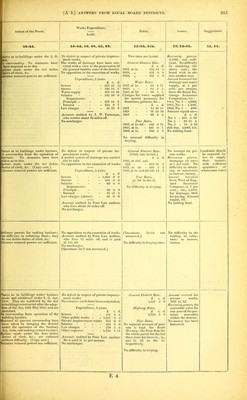
![Constitution of Local Board. Districts. Officers. Medical Advice. Inspection. Hospital Accommoda- tion. Treatment, &c. of Disease. Sewerage, &c. Water Supply, &c. Ons, 1, 8-12. 2-7, ^9-50. 13-15, a.9. ae-is, 20-28. 29-3&. 35-38, 57. 52. Stroud. (Gloucestershire). P. H. Act applied upon petition of the inhabitants. Jan. 1S57. The district comprises that part of the parish of Stroud which is situate within a mile of the parish church. A. (about) 990 0 0 R. V. - £17,500 0 0 P. (about) 7,500. H. (no change of import- ance since 1861). D. R. (no means of as- certaining). There is no adjoining dis- trict under a Local Board which should be included. A populous suburb on the outskirts of the town, . but in, the parish of Painswick. A. (about) - 30 R. V. (about) - 2,000 P. (about) - 800 might be advantageously incorporated for paving, lighting, water supply, and drainage. Surveyor and In- spector, 75/. per annum. No officer of health. An in- spector under the Factory Acts has the district in his charge., The officer of the Local Board acts as inspector un- der the Work- shops Act. There is also a cer- tifying surgeon. No advice from a medical source. Regular inspec- tion is made by surveyorand in- spector ; in time of cholera mem- bers of the board act personally as a visiting com- mittee. Inspection of food scai'cely effi- cient. No contribution to hos- pitals. No hospital where infec- tious diseases are ad- mitted. No disin fecting apparatus. Bird's sewage powder is very efficacious in dis- infecting sewers, and is generally used. Infected patients treated in their own houses. Coroner not a medical man. Guardians do little or nothing in respect of sanitary reports; an in- spectorof nuisances was appointed, but dis- charged, as is supposed, on account of cost. No registration of disease attempted. Epidemic disease ascer- tained through the medical men. Means sufficient where there is a small population. In- formation given is immediately acted upon. No record of death or disease in public insti- tutions is published. No special outbreak of disease since 1853 till last year, an outbreak of fever then occurred, in consequence of the pollution of water in a well by the sewage. Local authorities should have the power to for- bid the use of polluted well water. There is more fever in the crowded districts, on ac- count of dirty habits of the people. , Public sewerage is sufficient. Subsoil is not waterlogged. Sewers are ventilated by rain- pipes, and a few extra pipes against the houses. Sewers and house drains generally carefully trapped. Sewage is disposed of to Bird's Sewage Company, who deodorise it, and dispose of the solid mat- ter mixed withother manures; the water then discharged into the Frome. Amount realized, nominal. Houses generally have water- closets or privies. There are a few cesspools emptied very irregularly, and not much care taken in many instances. The whole of the town, except a few cottages, drain into the sewers. There are two ham- lets a mile distant not drained at all. Water supply is from water- works. Water laid on to each house occupied by tradespeople and other prin- cipal inhabitants ; as regards cottages, one cistern sup- plies three or four houses. Supply intermittent. No public reservoirs, but each householder collects rainfall in tanks, &c. There are no tenements in the town without water. The two hamlets are without adequate supply, and there are no means of relieving them except at very great expense. Total expenditure for water supply, 8,400/.; works partly within and partly without district. Four or five houses outside the district are sup- plied. No abandoned works. No imperfectly constructed works. t 53. Swafiham. (Norfolk). P. H. Act applied, by Order in Council, in 1850. 1 The district is contermi- nous with the parish of SVVAFFHAM. A. - 7,300 0 0 K. V. - £14,617 12 6 P. - 3,558. H. 886 (no change since 1861). D. R. 1866-7, 21. „ 1867-8, 32. „ 1868-9, 24. There is no adjoining dis- trict whicli should be included. Clerk, 251. per annum. In- spector of Nui- sances, Rate Col- lector, and Road Surveyor, 601. No other health officer, inspector or certifying surgeon (except scavengers [!]). Advice from medical men who at various times inform Nuisance Inspec- tor of fever, &c. There is no regu- lar system of inspection. No inspection of food. No contribution to hos- pitals; none in the district. No disin fecting apparatus nor plan for disinfect- ing sewers. Infectious cases are attended at their own homes. Coroner not a medical man. Epidemic disease ascer- tained through private information from medi- cal men. Means suffi- cient, and immediately acted on. One case of cholera oc- curred in October 1866; the premises were dis- infected with chloride of lime. No unliealthy district. Public seiverage not quite suffi- cient, and improvements are contemplated. Subsoil is not waterlogged. Sewers not venti- lated. Sewers and house drains are trapped. Contents of common privies is disposed of privately; liquid sewage from principal outfalls is irrigated on some few acres of private pastures, andsediment carted by tenant. The board are about to ascer- tain if there is a fall to carry sewage about li mile beyond the town. Proceeds nil. A few houses have waterclosets, which drain into dead wells. The privies of the drained por- tion of the town are capable of being converted into water- closets, and flushed; they are r\Tilm(\r~\ TiTiVV f'ps^nnols niifi ashpits. It is not known if they are deodorised. About three - fourths drain into sewers. Water supply is by aprivat.» water company, from a deep well or shaft. Small cot- tages use same tap, conveni- ently situated in yards and streets. Supply constant. Rainfall utilized by public ponds and private reservoirs, but larger portion goes down the public sewers. There are no tenements without water. No abandoned works. g](https://iiif.wellcomecollection.org/image/b21366081_0002_0266.jp2/full/800%2C/0/default.jpg)