Volume 2
First-[second] report of the Royal Sanitary Commission.
- Great Britain. Royal Sanitary Commission
- Date:
- 1869-1874
Licence: Public Domain Mark
Credit: First-[second] report of the Royal Sanitary Commission. Source: Wellcome Collection.
Provider: This material has been provided by London School of Hygiene & Tropical Medicine Library & Archives Service. The original may be consulted at London School of Hygiene & Tropical Medicine Library & Archives Service.
271/418 (page 251)
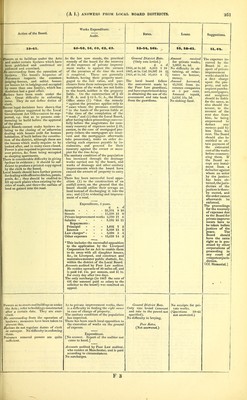
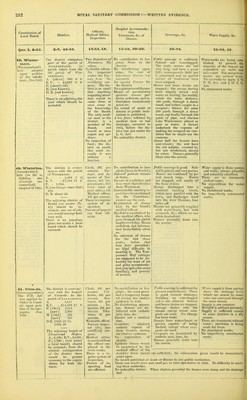
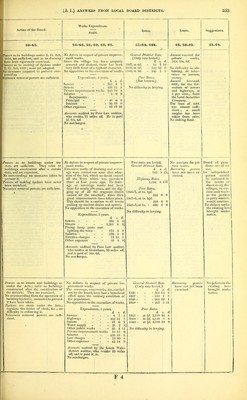
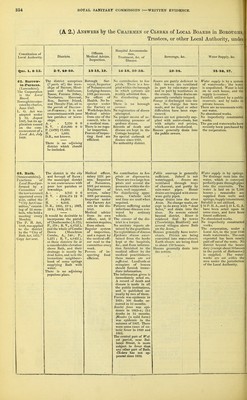
![Action of the Board. 39-45. Powers as to buildings under the Acts and under certain byelaws which have been published and confirmed are enforced and exercised. No overcrowding from the operation of byelaws. The board's Inspector of iVuisances inspects the common lodging-houses, and sublet houses (or houses let in lodgings and occupied by more than one family), which has doubtless had a good effect. Bijdaws have been made under the Act. Great difficulty in enforcing some. They do not define duties of cleric. Recent legal decisions have shown that many byelaws suggested by the Local Government Act Office cannot be sup- ported, e.g. that as to persons com- mencing to build before the approval of the plans. Local Boards cannot make byelaws re- lating to the closing of or otherwise dealing with houses unfit for human habitation, if built before the constitu- tion of the district, although these are the houses which really require to be looked after, and in many cases closed. Power is also required to prevent rooms over privies, &c. from being occupied as sleeping apartments. There is considerable difficulty in giving hyelaws in evidence ; it should be suf- ficient to produce a printed copy signed l)y the clerk to the board. Local boards should have further powers for dealing with offensive ditches, ponds, pools, &c.; they should be enabled to fill up such places when existing by the sides of roads, and throw the surface of land so gained into the road. Works Expenditure. Audit. 46-48, 56, 60, 62, 63. Rates. 52-54, 56k. As the law now stands, the practical remedy of the board for the recovery of the expenses of private improve- ment works is against the owners of the premises at the time the work is completed. These are generally builders, having their property mort- gaged to the full value, and pur- chasers from them subsequently to the completion of the works are not liable to the board, neitlier is the property liable. On the construction of § 69 P. H. A. and § 62 L. G. A., the Home Office states (1) that the remedy against the premises applies only to cases whore the premises continue in the hands of the person liable at the time of the completion of the work; and (2) that the Local Board, after having taken proceedings success- fully before the magistrates for sum- mary recovery of expenses under § 69, cannot, in the case of mortgaged pro- perty (where the mortgagors are insol- vent and the mortgagees afterwards take possession), make an order de- claring such expenses payable by in- stalments, and proceed for their recovery against the owner or occu- pier for the time being. The sanitary condition of the population has increased through the drainage works carried out by the board, and works of drainage and other sanitary improvements whicli tlie board have caused the owners of property to carry out. Tliere has been successful local oppo- sition (1) to the construction of an outfall sewer, on the ground that the board should utilize their sewage on land instead of discharging it into the sea; and (2) to widening and improve- ment of a road. Expenditure, 3 years. £ s. d. Sewers - - - - 33,191 9 10 Streets - - - - 11,538 13 0 Private improvement works 2,570 17 6 General District Rate. (Only rate levied.) £ s. 1866, at Is. 2d 6,163 1 1867, at Is. 11(7. 10,507 18 1868, atls. 9ii. 10,483 4 The local board follow the assessment made by the Poor Law guardians, and have experienced delay in obtaining the use of the assessment and rate book from the guardians. Salaries Repayments: Principal Interest Law charges* - Other expenses 3,192 16 11 1,892 7 5,038 13 3,098 3 15,658 14 * This includes the successful opposition to the application by the Liverpool Corporation for an Act to enable them to do away with all slaughter houses, &c., [in Liverpool, and construct and maintainamonster public abattoir, &c. within the district of the Local Board. Accounts audited by Poor Law auditor. He resides upwards of 30 miles off, and is paid lil. 14s. per annum, and 1/. Is. for every day after two days. The only surcharge (in 1867 the sum of 63?. the ' amount paid as salary to the solicitor to the board) was remitted on appeal. Loans. 55, 58-61. Amount received for private works, 2,988/. 4s. id. No difficulty in ob- taining, or reluc- tance to borrow, money. Amomit borrowed, 45,585/. from in- surance companies at 5 per cent. Amount repaid, 2,256/. 15s. Sd. No sinking fund. Suggestions. 51, 64. The expenses in- curred by the Board in re- spect of private improvement works should be a first charge upon the pro- perty, and sub- sequent purcha- sers, mortgagees, and assignees should be liable for the same, as also should the tenant, to the amount of the rent due from him, lie beinj empowered to deduct any moneys paid by him from his rent. The Board should also be entitled to ob- tain payment of the estimated cost of the works before commen- cing them. If the Board ac- cept any instal- ment from defaulter against whom an order by the justices has been ob- tained, the juris- diction of the justices is there- by ousted, and the order cannot afterwards be enforced. The proceedings for the recovery of expenses due to the Board for private improve- ments have to be taken before justices of the peace. The Board should have the same right as is pos- sessed by other corporations of proceeding in any court of competentjuris- diction. CCf. Memorial.] Powers as to streets and buildings as under the Acts ; refer to buildings constructed after a certain date. They are exer- cised. No overcrowding from the operation of byelaws ; measures have been taken to prevent this. Byelaws do not regulate duties of clerk or surveyor. No difficulty in enforcing them. Nuisance removal powers are quite sufficient. As to private improvement works, there is a difficulty in finding the right owner in case of change of property. Tlie sanitary condition of the population has improved. There has been much local opposition to the execution of works on the ground of expense. Expenditure. [No answer. Report of the auditor not come to hand.] Accounts audited by Poor Law auditor, who resides at Manchester, and is paid according to circumstances. No surcharges. General District Rate. Only rate levied (amount and rate in the pound not specified). No difficulty in levying. Poor Rates. (Not answered.) No receipts for pri- vate works. (Questions 58-61 not answered.)](https://iiif.wellcomecollection.org/image/b21366081_0002_0271.jp2/full/800%2C/0/default.jpg)