Volume 2
First-[second] report of the Royal Sanitary Commission.
- Great Britain. Royal Sanitary Commission
- Date:
- 1869-1874
Licence: Public Domain Mark
Credit: First-[second] report of the Royal Sanitary Commission. Source: Wellcome Collection.
Provider: This material has been provided by London School of Hygiene & Tropical Medicine Library & Archives Service. The original may be consulted at London School of Hygiene & Tropical Medicine Library & Archives Service.
294/418 (page 274)
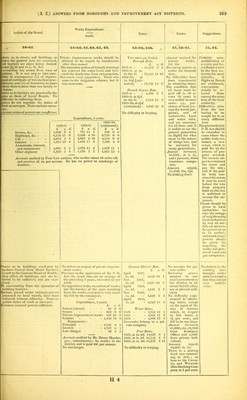
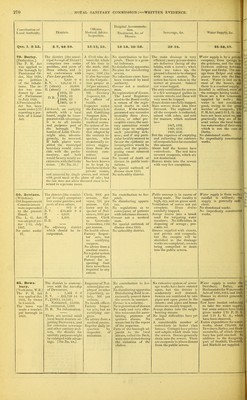
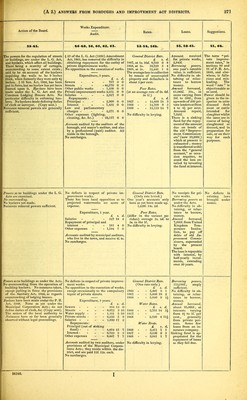
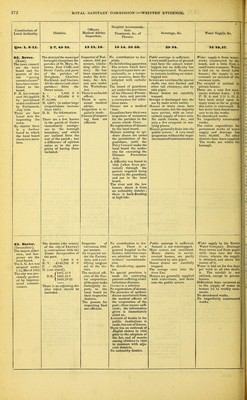
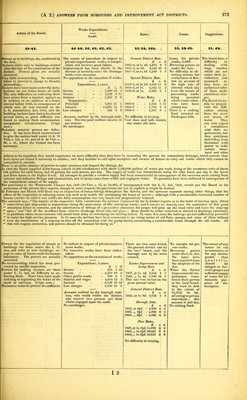
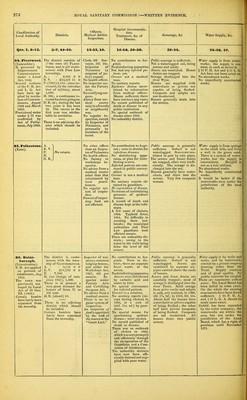
![Constitution of Local Authority. Districts. Officers. Medical Advice. Inspection. Hospital Accommoda- tion. Treatment, &c. of Disease. Sewerage, &c. Water Supply, &c. Qns. 1, 8-12. 2-7, 49-50. 13-15, 19. 16-18, 20-28. 29-34. 35-38, 57. 84:. Fleetwood. (Lancashire). Is governed by Improvement Commissioners under a Local Act, 1842. Several sections of the P. H. Act and L. G. Act have been ap- plied by resolu- tion of Commis- sioners, August 1868 and March 1869. Provisional order under § 77 vcas confirmed by Act of Parlia- ment, July 1869. The district consists of [? the town of] Fleet- wood, and is not conter- minous with Poor Law townships. A. - - 2,848 0 0 R. V. - £14,417 15 0 P. (1861)3,555; since in- creased, by the introduc- tion of military, about 1,000. H. 506; a continuous in- crease has been goingon, D. R. 26; during the last two years it has been 22. The excess in the first year was attribu- table to scarlatina. There is no adjoining dis- trict which should be included. Clerk, 30/. Sur- veyor, 59/. 16s. Inspector of Nuisances (a sergeant of po- lice) unpaid. No health officer. No inspector un- der the Factory Acts. No certifying sur- geon. Advice from me- dical source onlyinafriendly or neighbourly way. No regular in- spection, except by Inspector of Nuisances, and personally by members of the board. No contribution to hos- pitals. No disinfecting apparatus. Not had any infected pa- tients yet. Coroner not a medical man. No sanitary reports. Epidemic disease ascer- tained by information from medical officer. Means sufficient; there have not been any cases. No record published of death or disease in any public institution. No special outbreak of disease since 1853. No unhealthy district. Public sewerage is sufficient. Not a waterlogged soil, being porous and sandy. Sewers not ventilated. House drains are trapped. Sewage discharged into the river Wyre. Houses are supplied with waterclosets or privies not capable of being flushed. Cesspools and ashpits are not deodorised. Houses generally drain into the sewers. Water supply is from water- works; the supply is con- stant, to such as desire it. § 76 P. H. Act and § 51 L. G. Act have not been acted on. No abandoned works. No imperfectly constructed works. 85. Folkestone. (Kent). A. ^ R. V. P. l-No return. H. D. R.J No other officer than an Inspec- torofNuisances. No health officer. No factory or workshops in- spector. No advice from a medical source other than that volunteered by local practi- tioners. No regular sys- tem of inspec- tion. Powers of inspec- ting food are not efficient. No contribution to hospi- tals; none in district for infectious diseases. No disinfecting appa- ratus, or plan for disin- fecting sewers. Infected patients are con- veyed in public convey- ances. Coroner is not a medical man. No sanitary reports ob- tained by guardians. No registration of disease. No means of ascertaining presence of epidemic disease. A record of death and disease kept at the infir- mary. A few cases of cholera, 1866. Tvphoid fever, 1864. No difficulty in meeting these out- breaks ; the municipal authorities and Poor Law guardians took efficient means. There are unhealthy dis- tricts ; owing to the water in the wells being helow the level of the sewers. Public sewerage is generally sufficient. Subsoil is not water] ogged. Sewers are ven- tilated in part by rain pipes. The sewers and house drains are trapped, often very ineffi- ciently. The sewage is dis- charged into the sea. Houses generally have water- closets, and drain into the sewers. Very few cesspools remain. Waaler supply is from springs in the chalk hills, and from a well in the green sand. There is a system of water- works, but the supply is intermittent. Rainfall is not as a rule utilized. No abandoned works. No imperfectly constructed works. It would be better if the waterworks were under the jurisdiction of the local authority. 86. Galns- boroa§^Ii. (Lincolnshire). P. H. Act applied on petition of inhabitants, Aug. 1852. The town was previously ma- naged by Local Act of 49 Geo. III. (1809). Certain hamlets have lately been separated from the township. The district is conter- minous with the town- ship of Gainsborough. A. - - 3,156 0 0 R. V. £21,750 0 0 P. - 7,500. H. (no change of note since 1861), 1,400. There is at present a very great demand for houses of from 11. to 10/. rent. D. R. (about) 24. There is no adjoining district which should be included. Certain hamlets have lately been separated from the township. Inspector of nui- sances, common lodging-houses, and under the Workshops Act, ] 867, 40/. per annum. In- spector under Factory Acts and Certifying Surgeon Act. No advice from a medical source. There is no re- gular system of inspection. An inspector of food is appointed by the lord of the manor at the Court Leet. No contribution to hos- pitals. None in dis- trict ; there are separate fever wards at the union. No disinfecti ng apparatus. Sewers were disinfected by carbolic acid and water in 1866. No special conveyance for infected patients. Coroner is a solicitor. No sanitary reports (ex- cept during cholera in 1866, at a cost of 266/. lis. 4rf.) by guar- dians. No special means for ascertaining epidemic disease; none needed. No record published of death or disease. There was an outbreak of cholera in 1866, which was metpromptly and efficiently through the co-operation of the Guardians and a Com- mittee of inhabitants. The unhealthy districts have now been effi- ciently drained and sup- plied with pure water. Public sewerage is generally sufficient. Subsoil is not waterlogged. Sewers are ventilated by separate air- pipes carried above the roofs of houses. Sewers and ho7ise drains are carefully trapped; most of sewage is discharged into the river Trent. Solid sewage from privy vaults and ashpits is sold, and realized, in 1868, 28/. 17s. 9c/,; in 1869, 30/. 10s. About half the houses have waterclosets or privies capable of being flushed ; the other half have privies incapable of being flushed. Cesspools are not deodorised. All houses drain into public sewers. Water supply is by wells and tanks, and by waterworks erected by a private company drawing water from the Trent. Supply constant, and of good quality. No public reservoir for rainfall. There are tenements without water. The Local Board has been defied in some cases. On the whole the existing enactments have been found sufficient. § 76 P. H. A., and § 51 L. G. A. should be made more exact. 10,000/. has been expended by the water company; the waterworks are within the area, but not under the jurisdiction of the Local Board, which has a right of purchase until November 1871.](https://iiif.wellcomecollection.org/image/b21366081_0002_0294.jp2/full/800%2C/0/default.jpg)