Volume 2
First-[second] report of the Royal Sanitary Commission.
- Great Britain. Royal Sanitary Commission
- Date:
- 1869-1874
Licence: Public Domain Mark
Credit: First-[second] report of the Royal Sanitary Commission. Source: Wellcome Collection.
Provider: This material has been provided by London School of Hygiene & Tropical Medicine Library & Archives Service. The original may be consulted at London School of Hygiene & Tropical Medicine Library & Archives Service.
38/418 (page 30)
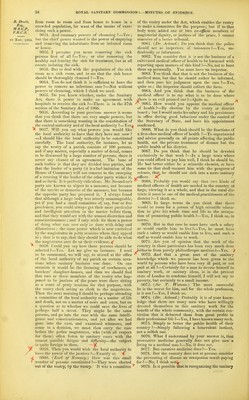
![R. Druitt, method of scavenging in Bristol, where it appears that the people assist in cleaning their yards tlaemselves ; FRCS noticed that that has been feasible at all ; J within your experience ?—I should think it was, but 18 Nov. 1869. virtually it is not done by the population that I have — had anything to do with. 8992. In Bristol it was brought about, was it not, by a very simple and efficient means of local inspec- tion ?—Yes. 8993. It was of course impossible for you personally to inspect those crowded districts with which you had to do ?—I did inspect them, but with regard to the cleanliness of the streets that was under parish regu- lation, and it was done in a certain way, and at a cer- tain expense ; and any additional cleansing, as I under- stood, was resisted because it would cost too much. 8994. You are a robust man, and able to undergo the great physical labour of examining all those poor places, and you were very inadequately paid, but every medical officer I presume could not do it ?—No ; but every medical officer must go into them enough to see what is the nature of the population and the houses that he has to deal with. 8995. Are you satisfied with the general arrangements for water supply under the existing Acts ?—In London there is plenty of water given, and I only know London, but it is immensely wasted in the houses of the poor ; this is a matter rather of distribution than of supply ; but there is quite an adequate supply, that is to say, there might be an adequate supply. 8996. Have you had much observation of the state of overcrowding among the poor ?—Yes. 8997. Could you state to the Commission the chief results that you have seen to ensue from that cause ?— There is a general lowering of health, a degradation as it were of the whole system and character accompany- ing overcrowding; but we have not in the parish that I was concerned with anything very gross except as an exception. 8998. You probably, from your colleagues in the association of officers of health, have, however, learnt a great deal about it in the East of London ?—Yes, 8999. Is it possible, do you think, to prevent it ?— I very much doubt it, because I suspect that it arises in the first place from poverty, and the desire of warmth; and in the next place from utter ignorance or recklessness ; overcrowding is a compound of those two causes, the moral status of the population and their means. 9000. What diseases do you think are chiefly pro- duced by overcrowding ?—I should think typhus and bronchitis. 9001. Is not the overcrowding accompanied also, generally speaking, by want of drainage ?—Yes, that follows of necessity, that where many human beings are put together on an inadequate space of land, they never can get out of the odour of their own breath and of their own excretions. 9002. (^Chairman.') Are you talking now of the overcrowding of houses, or the overcrowding of people in houses ?—Of both. 9003. Acland.) That is to say, of the over- crowding of houses on a particular spot of land, by first making them too close together, and then, secondly, by putting too many persons in one room ?—I think they go together generally. 9004. But the first of those evils, overbuilding, is a question depending upon their local Acts and byelaws, is it not ?—Yes; but in such a parish as I am acquainted with there are many old houses and old premises at the fag end of leases which fall into poor hands and become overcrowded, and yet which there was not at that time any power to pull down or alter. 9005. Have you found that the existing laws are inadequate to remedy existing evils, although they may be adequate to hindering the introduction of errors with regard to the construction of new houses; can you always alter or close insufficient and improper buildings ?—No, not always ; but more can be done now than we used to be able to do, and more than could have been done formerly. ^ ( 9006. Then as to the second point, the personal overcrowding in rooms, is that a preventible evil ?—I believe so, if the Sanitary Act were put in execution. The Common Lodging Houses Act is a different thing, the lodging houses where people are received for the night are under admirable regulation. I have seen that myself personally by going into South- wark and Whitechapel; but with regard to those houses that are let out in separate tenements or x'ooms for the labouring population, our vestry refused to put into operation the clauses of the Sanitary Act, which would have given ample power for the regulation of those houses. The medical officers of health devoted enormous time and trouble to drawing up a code of regulations under the Sanitary Act, which would have brought every such house under control, limited the number of inmates, and secured their cleanliness; but the vestry of the parish that I was connected with refused to put that clause of the Act in operation. ^ 9007. Are there no more recent Acts upon the sub- ject ?—Yes, Mr. Torrens' Act. 9008. Have you a copy of the regulations which the medical officers of health drew up?—I beg to hand in one to the Commission. [The same was delivered in, and is as follows ;) Copy of Ue&ulations drawn up by a Committee of Medical Officers of Health, for the Management of Lodging Houses, under the Sanitary Act, 1866. Regulations in regard to Houses or Parts of Houses, which are let in Lodgings or occupied by Members of more than One Family. Parish [or district] of I'o Wit. Whereas, by an Act of Parliament made and passed in the 29th and 30th years of the reign of Her present Majesty Queen Victoria, intituled An Act to amend the law relating to the public health, it is enacted that— On application to one of Her Majesty's Principal Sec- retaries of State by the nuisance authority of the city of London, or any district or parish included within the Act for the better local government of the metropolis, or of any municipal borough, or of any place under the Local Govern- ment Act, 1858, or any local improvement Act, or of any city or town containing, according to the census for the time being in force, a population of not less than 5,000 inhabitants, the Secretary of State may, as he may think fit, by notice to be published in the London Gazette, declare the following enactment to be in force in the district of such nuisance authority, and from and after the publication of such notice the nuisance authority shall be empowered to make regulations for the following matters ; that is to say : 1. For fixing the number of persons who may occupy a house or part of a house which is let in lodgings or occupied by members of more than one family. 2. For the registration of houses thus let or occupied in lodgings. 3. For the inspection of such houses, and the keeping the same in a cleanly and healthy state. 4. For enforcing therein the provision of privy accom- modation and other appliances and means of cleanliness in proportion to the number of lodgings and occupiers, and the c .eansing and ventilation of the common passages and staircase s. 5. For the cleansing and lime-whiting at stated times of such premises. The nuisance authority may provide for the enforce- ment of the above regulations by penalties not exceeding 40s. for any one ofPence, with an additional penalty not exceeding 20s. for every day during which a default in obeying such regulations may contitme; but such regula- tions shall not be of any validity unless and until they shaL have been confirmed by the Secretary of State. And whereas the Right Hon. , one of Her Majesty's Principal Secretaries of State for the Home De- partment, did, by notice published in the London Gazette on the , declare the said enactment to be in force in the parish [or districf] of : Now, we, the nuisance authority acting in and for the said parish [or district], do, in pursuance of the power conferred upon us by the 35th section of the statute above named, make the following regulations; tha* is to say,—](https://iiif.wellcomecollection.org/image/b21366081_0002_0038.jp2/full/800%2C/0/default.jpg)