Every-day wonders of bodily life / by Anne Bullar.
- Anne Bullar
- Date:
- [between 1800 and 1899]
Licence: Public Domain Mark
Credit: Every-day wonders of bodily life / by Anne Bullar. Source: Wellcome Collection.
Provider: This material has been provided by The University of Glasgow Library. The original may be consulted at The University of Glasgow Library.
50/72 (page 72)
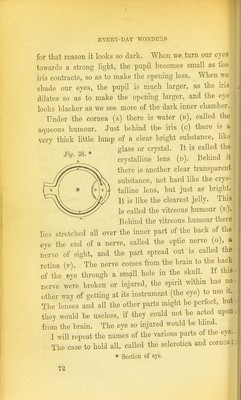
![for that reason it looks so dark. When we turn our eyes! towards a strong light, the pupil becomes small as the ( iris contracts, so as to make the opening less. When we I shade our eyes, the pupil is much larger, as the insl dilates so as to make the opening larger, and the eyei looks blacker as we see more of the dark inner chamber..;! Under the cornea (a) there is water (b), called the aqueous humour. Just behind the iris (c) there is a j very thick little lump of a clear bright substance, like! glass or crystal. It is called the crystalline lens (d). Behind it there is another clear transparent substance, not hard like the crys-1 talline lens, but just as bright.] It is like the clearest jelly. This is called the vitreous humour (e)| Behind the vitreous humour there lies stretched all over the inner part of the back of the j eye the end of a nerve, called the optic nerve (o), a nerve of sight, and the part spread out is called the retina (f). The nerve comes from the brain to the back of the eye through a small hole in the skull. If this, nerve were broken or injured, the spirit within has no other way of getting at its instrument (the eye) to use it. The lenses and all the other parts might be perfect, but they would be useless, if they could not be acted upon from the brain. The eye so injured would be blind. I will repeat the names of the various parts of the eye. The case to hold all, called the sclerotica and cornea'* * Section of eye.](https://iiif.wellcomecollection.org/image/b21460206_0050.jp2/full/800%2C/0/default.jpg)