Essentials of surgery : together with a full description of the handkerchief and roller bandage. Arranged in the form of questions and answers prepared especially for students of medicine / by Edward Martin.
- Edward Martin
- Date:
- 1890
Licence: Public Domain Mark
Credit: Essentials of surgery : together with a full description of the handkerchief and roller bandage. Arranged in the form of questions and answers prepared especially for students of medicine / by Edward Martin. Source: Wellcome Collection.
Provider: This material has been provided by the Augustus C. Long Health Sciences Library at Columbia University and Columbia University Libraries/Information Services, through the Medical Heritage Library. The original may be consulted at the the Augustus C. Long Health Sciences Library at Columbia University and Columbia University.
221/324 (page 219)
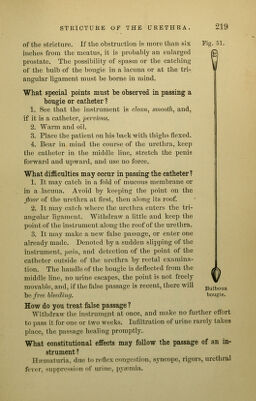
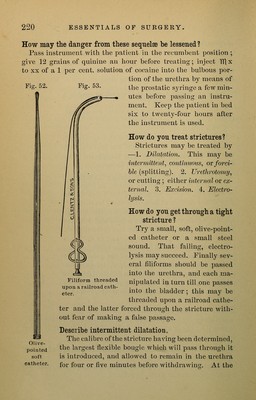
![of the stricture. If the obstruction is more than six Fig. 51. inches from the meatus, it is probably an enlarged prostate. The possibility of spasm or the catching of the bulb of the bougie in a lacuna or at the tri- angular ligament must be borne in mind. What special points must be observed in passing a bougie or catheter ? 1. See that the instrument is clean, smooth, and, if it is a catheter, permous. 2. Warm and oil. 3. Place the patient on his back with thighs flexed. 4. Bear in mind the course of the urethra, keep the catheter in the middle line, stretch the penis forward and upward, and use no force. What difficulties may occur in passing the catheter? 1. It may catch in a fold of mucous membrane or in a lacuna. Avoid by keeping the point on the floor of the urethra at first, then along its roof. 2. It may catch where the urethra enters the tri- angular ligament. Withdraw a little and keep the point of the instrument along the roof of the urethra. 3. It may make a new false passage, or enter one already made. Denoted by a sudden slipping of the instrument, fjain, and detection of the point of the catheter outside of the urethra by rectal examina- tion. The handle of the bougie is deflected from the middle line, no urine escapes, the point is not freely movable, and, if the false passage is recent, there will bulbous be free bleeding. bougie. How do you treat false passage ? Withdraw the instrument at once, and make no further effort to pass it for one or two weeks. Infiltration of urine rarely takes place, the passage healing promptly. What constitutional effects may follow the passage of an in- strument ? Hfematuria, due to reflex congestion, syncope, rigors, urethral fever, sujjpression of urine, ])ytemia.](https://iiif.wellcomecollection.org/image/b21213562_0221.jp2/full/800%2C/0/default.jpg)