Pain, pleasure and æsthetics : an essay concerning the psychology of pain and pleasure, with special reference to æsthetics / by Henry Rutgers Marshall.
- Henry Rutgers Marshall
- Date:
- 1894
Licence: Public Domain Mark
Credit: Pain, pleasure and æsthetics : an essay concerning the psychology of pain and pleasure, with special reference to æsthetics / by Henry Rutgers Marshall. Source: Wellcome Collection.
Provider: This material has been provided by King’s College London. The original may be consulted at King’s College London.
20/396
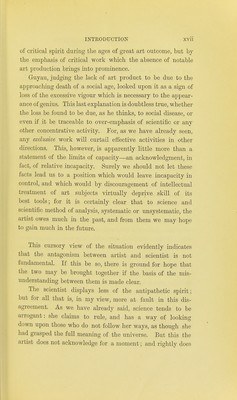
![scientist's labours in the past, and often in an unsystematie way adopting his methods of technical discovery This second point need not detam us, and therefore may best be illustrated at once. I may mention as a typica example the use of perspective, without which the pictorial artist of to'-day cannot do his work; but perspective is evidently a purely mathematical science in its ongm and although certain short cuts are used commonly which are not reasoned out, perspective itself cannot be used effectively apart from a clear knowledge of the principles mvolved One has but to compare the drawing of Diirer's day and of Tadema's to see how much this special science has affected art It is interesting to note in this connection that among the Frenchmen who have taken to themselves the name impressionists [a term which really should have a fuller application], the pointilhsts, Dubois-Pillet and Seurat, are found studying as they work, the one from Eood's theory of colours the other from Chevreul's writings on smiultaneous contrast It is not necessary to multiply examples in this direction, and we may well turn back to consider the depend- ence of art upon those qualities which seem to be distmct- ively scientific. Science, in its essence, is but the orderly arrangement ot human experience; and surely the experience of our an- cestors is made use of daily in art method and practice. No age has given more study to ancient art than ours is giving. At no time have artists turned more attention to the t)ld masters than in our own day. It is apparent, therefore that esthetic method is in reality developing in line with the body of science, although the crudeness of its form prevents the general recognition of its relation to what we call science. A further view makes this clearer. As we look back at the great epochs of art, at the styles they produced, the schools they founded, we see the outcome](https://iiif.wellcomecollection.org/image/b21293831_0020.jp2/full/800%2C/0/default.jpg)



 No text description is available for this image
 No text description is available for this image
 No text description is available for this image