Cerebral and mental symptoms in relation to somatic disease, anaesthetics and toxic agents, traumata and surgical procedures : with a review of the treatment of some cerebral and mental symptoms by operation ... / by James Christian Simpson.
- Simpson, J. Christian (James Christian)
- Date:
- 1898
Licence: Public Domain Mark
Credit: Cerebral and mental symptoms in relation to somatic disease, anaesthetics and toxic agents, traumata and surgical procedures : with a review of the treatment of some cerebral and mental symptoms by operation ... / by James Christian Simpson. Source: Wellcome Collection.
19/210 page 7
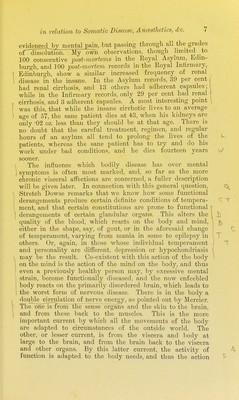
![evidenced^b^entaljain, but passing through all the grades or^issolution. My own observations, though hinited to 100 consecutive post-mortems in the Royal Asyluni, Edin- burgh, and 100 post-mortem records in the Royal Iniirmary, Edinburgh, show a similar increased frequency of renal disease in the insane. In the Asylum records, 39 per cent had renal cirrhosis, and 13 others had adherent capsules; while in the Infirmary records, only 29 per cent had renal cirrhosis, and 3 adherent capsules. A most interesting point \ was this, that while the insane cirrhotic lives to an average age of 57, the .sane patient dies at 43, when his kidneys are only -02 oz. less than they should be at that age. There is no doubt that the careful treatment, regimen, and regular hours of an asylum all tend to prolong the lives of the patients, whereas the sane patient has to try and do his work under bad conditions, and he dies fourteen years sooner. The influence which bodily disease has over mental symptoms is often most marked, and, so far as the more chronic visceral affections are concerned, a fuller description will be given later. In connection with this general question, Stretch Dowse remarks that we know how some functional derangements produce certain definite conditions of tempera- ment, and that certain constitutions are prone to functional ]- derangements of certain glandular organs. This alters the 1 quality of the blood, which reacts on the body and mind, either in the shape, say, of gout, or in the aforesaid change of temperament, varying from mania in some to epilepsy in others. Or, again, in those whose individual temperament and personality are different, depression or hypochondriasis ' may be the result. Co-existent with this action of the body on the mind is the action of the mind on the body, and thus even a previously healthy person may, by excessive mental strain, become functionally diseased, and the now enfeebled body reacts on the primarily disordered brain, which leads to the worst form of nervous disease. There is in the body a double circulation of nerve energy, as pointed out by Mercier. The one is from the sense organs and the skin to the brain, and from these back to the muscles. This is the more important current by which all the movements of the body are adapted to circumstances of the outside world. The other, or lesser current, is from the viscera and body at large to the brain, and from the brain back to the viscera and other organs. By this latter current, the activity of function is adapted to the body needs, and thus the action](https://iiif.wellcomecollection.org/image/b20391183_0019.jp2/full/800%2C/0/default.jpg)