An account of what appeared on opening the coffin of King Charles the First, in the vault of King Henry the Eighth in St. George's Chapel at Windsor, on the first of April, MDCCXIII / by Sir Henry Halford.
- Halford, Henry, 1766-1844.
- Date:
- 1813
Licence: Public Domain Mark
Credit: An account of what appeared on opening the coffin of King Charles the First, in the vault of King Henry the Eighth in St. George's Chapel at Windsor, on the first of April, MDCCXIII / by Sir Henry Halford. Source: Wellcome Collection.
Provider: This material has been provided by Royal College of Physicians, London. The original may be consulted at Royal College of Physicians, London.
25/66
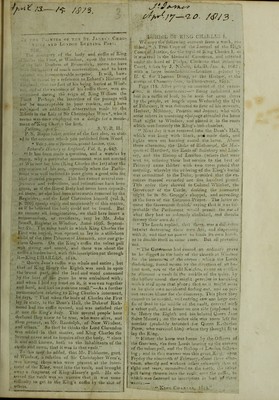
![;3.—/y. /JVS. ,j T [f f STEtt OK THE St. Ja::ess Ciiko- >,'i and Lo ndon Evening Post. SIR, '• Tin u‘>>coj:?ry of the body and coffin of King .! i . ... tlie Kifst, at Windsor, upon the interment .,i ■ ! ] i > • .Duchess of Brunswick, seems to have ■■ -j,e sobje t of much conversation, and to have i-xcited r:i. inconsiderable surprise. It will, l.ow- . , , j<; ],v a reference to Echard s History of L.ijn ; tli.it toe fact of his being buried at Wind- sor, .o: tut the’existence of his coffin there, was a$- ci rt.iiued during the reign of King William the a :,ii’rt Perhaps the insertion of the passage will not he unacceptable to your readers, and I have subjoined an additional observation made by the Editor in the Life ol Sir Christopher Wren*, who it seems was once employed on a design lor a rnonti- lnent oPKing CliarLs the first. Fulham, .iputG. S. V. II. II. P.'S, llapin taker, notice of the fact also, as stat- ed in the account which you published from Wood. * Vide p.-320 o; Paremaiia, printed Loudon, 1730. Echard'x IIis forg oj, England, lul.. 2, p. 64<). 1 'c It has been made a question, atul a wonder by many, why a particular monument was not erected I at Win isor for him (King Charles the 1st) after the jest ora,: ion of his son, especially when the Parlia- ment was well inclined to have given a good sum for that grateful purpose. This has caused several con- jectures and reflections, and intimations have been given, as if the Royal Body had never been deposit- ed there, or else hatl been af terwards removed by the .Regicides; and the Lord Clarendon himself (vul. 3, p. 200) speaks softly and suspiciously of this matter, as if bebelieved the hotly could not be found. But to remove all imaginations, we shall litre insert a memorandum, or certificate, sent bv Mr. John Sewell, Register at Windsor, Anno l6p6, Septem- ber. 21. The same vault in winch King Charles the First was buried, was opened to lay in a still-born ; child of the. then ‘Princess of 1/enpiavk, now our gra- cious Queen. On the King’s coffin the velvet pall was strong and sound, and there was about the coffin a leaden band, with this inscription cut through I it—King CHARLES. l6f8. Queen Jane's coffin was whole and entire ; hut that .of King Henry the Eighth was sunk in upon the breast part, and the lead and wood consumed by the beat of the gums lie was embalmed with; and when I laid my hand on it, it was tun together and bard, and bad no noisome smell.”—As a further memorandum relating to King Charles’s interment, he says, “ I bat when the body of Charles the First lay in state, in the Dean’s Hall, the Duke of Rich- mond had the coffin opened, and was satisfied that it wax tin; King's br,dy. This several people have declared {hey knew to he true, who were alive, and then present, as Mr. Randolph, of New Windsor, and others.” So that he thinks the Lord Clarendon was misled in that matter, and King Charles the Second ngver sent to inquire after the body, “ since it was well known, both to the inhabitants of the cattle and town, that it was in that vault.” To this may be added, that Mr. Fishborne, gent, of Windsor, a relation of Sir Christopher Wren’s, was among those who were preset!t at the inter- ment of the King, went into the vault, and brought away a fragment of King Henry’s pall. He ob- served the vault was so narrow that it was some difficulty to get in the King's coffin by the sine of others. ly-vo. /(F/3. BUUML 5F KING CHAKLL3 i. We copy the following account from a woib, en- titled,! ‘‘ A True Copy of the Journal of the High Court of Justice, for 'the tryal of King Charles 1. as it was read in tlie'House of Commcns, and attested under the.hand of Phelps, Civile to that’infant us Court, t ken by J. Nilsott, LL. D. Jan. 4, 1683 ; with a large introduction —Loudon:, punted !; II. V. for Thomas Dring, r.t the Harrow, at the corner of Chancery-'ane, it) Fleet-street, 1654.” Page I 18. After giving an account of the execu- tion, it thus, continues:—Being iuibalmed and laid in a coffin of lead, to.be Seen for some dayes by the people, at length upon Wednesday the 171ii of February, it was delivered to tour of his servants, Herbert, Mildiitay, Preston and Joyner; who with some others in mourning equipage attended the berse Fhat night to Windsor, and placed it in the room which was formerly the King’s bed-chamber. “ Next Jay it was removed into the Dean's Hall, which was hung with black, made dark, and lights were set burning round the herse. About three afternoon, the Duke of Richmond, the Mar- quess of Hartford, the Earls of Salisbury and Lind- sey, and tire Bishop of London (others that were sent to, refusing 'their last service to the l est of Princes) came thither with two votes passed that morning, wherebv the ordering of the King’s burial was committed to the Duke, provided that the ex- pences thereof exceeded not five hundred pound. This order tbev shewed to Colonel Whichot, the Governour of the Castle, desiring the interment might he in St. George’s chap pci, and according to the form of the Common Prayer. The latter re- quest the Governotrr denied, saying th.it it was im- probable the Parliament Would permit the use ol what they had so solemnly abolished, and therein destroy their own Ai “ The Lords replied, that there was a dif; rc.nce betwixt destroying their own Act, and dispensing with it, and that no power so hinds its own hamb, as to disable itself in some cases. But all prevailed not. “ The Gov#ninur bad catiscd an ordinary grave to be digged in tire bodv of the church at Windsor for the intennevit of the corpse ; w hich the Lords disdaining, found means by the direction of an ho- nest man, one of the old Knights, to use an artifice to discover a vault in the middle of the quire, by the hollow sound tbev might perceive in knocking with h staff upon that place ; that so it might seem to he their own accidental finding out, and no per- son receive blame for the discoveiv. This place they caused to be opened, and cutting saw one large cof- fin of lead in the middle of the vault, covered with a velvet pall, and a lesser on one side (supposed 10 he Henry the Light!) and bis. beloved Queen .Jane Saint Manse); on the other side was room left for another (probably intended for Queen Katherine Parre, who survived him) where they thought fit to iay the King. “ Hither the herse was borne by the Officers of the Garrison, the four Lords hearing up rite corners of the velvet pal!, and the Bishop of LdO ’on follow- ing ; and in this manner was ibis great King, upon Fry day the ninetceth of February, about three after- noon. silently and without other solemnity that’, of sigtis and tearc, committed to the earth, the velvet pall living thrown into the vault ovi-r ?he coffin, to which was fastened an inscription in lead of three words: — “■.T&fjKa Ch ip' r.s, l6':3.”](https://iiif.wellcomecollection.org/image/b28406175_0025.jp2/full/800%2C/0/default.jpg)