Seed and soil inoculation for leguminous crops / by W.B. Bottomley.
- Bottomley, William Beecroft, 1863-1922.
- Date:
- 1907
Licence: In copyright
Credit: Seed and soil inoculation for leguminous crops / by W.B. Bottomley. Source: Wellcome Collection.
Provider: This material has been provided by The Royal College of Surgeons of England. The original may be consulted at The Royal College of Surgeons of England.
18/32 page 16
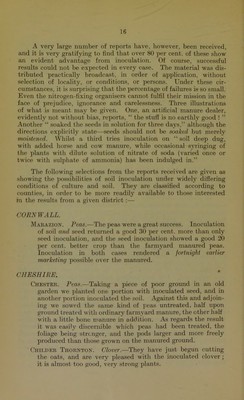
![A very large number of reports have, however, been received, and it is very gratifying to find that over 80 per cent, of these show an evident advantage from inoculation. Of course, successful results could not be expected in every case. The material was dis- tributed practically broadcast, in order of application, without selection of locality, or conditions, or jiersons. Under these cir- cumstances, it is surprising that the percentage of failures is so small. Even the nitrogen-fixing organisers cannot fulfil their mission in the face of prejudice, ignorance and carelessness. Three illustrations of what is meant may be given. One, an artificial manure dealer, evidently not without bias, reports, “ the stuff is no earthly good ! ” Another “ soaked the seeds in solution for three days,” although the directions explicitly state—seeds should not be soaked but merely moistened. Whilst a third tries inoculation on “ soil deep dug, with added horse and cow manure, while occasional syringing of the ])lants with dilute solution of nitrate of soda (varied once or twice with sulphate of ammonia) has been indulged in.” The following selections from the reports received are given as showing the possibilities of soil inoculation under widety differing conditions of culture and soil. They are classified according to counties, in order to be more readily available to those interested m the results from a given district :— CO/fAlFALL. M.vrazion. Peas.—The peas were a great success. Inoculation of soil and seed returned a good 30 per cent, more than only .seed inoculation, and the seed inoculation showed a good 20 ])er cent, better crop than the farmyard manured peas. Inoculation in both cases rendered a fortnight earlier marketing possible over the manured. CHESHIRE. Chester. Peas.—Taking a piece of poor ground in an old garden we planted one portion with inoculated seed, and in another portion inoculated the soil. Against this and adjoin- ing we sowed the same kind of peas untreated, half upon ground treated with ordinary farmyard manure, the other half with a little bone manure in addition. As regards the result it was easily discernible which peas had been treated, the foliage being stronger, and the pods larger and more freely produced than those grown on the manured ground. Childer Thornton. Clover.—They have just begun cutting the oats, and are very pleased with the inoculated clover; it is almost too good, very strong plants.](https://iiif.wellcomecollection.org/image/b22446588_0020.jp2/full/800%2C/0/default.jpg)