Histology; normal and morbid.
- Dunham, Edward K. (Edward Kellogg), 1860-1922
- Date:
- 1898
Licence: Public Domain Mark
Credit: Histology; normal and morbid. Source: Wellcome Collection.
Provider: This material has been provided by the Augustus C. Long Health Sciences Library at Columbia University and Columbia University Libraries/Information Services, through the Medical Heritage Library. The original may be consulted at the the Augustus C. Long Health Sciences Library at Columbia University and Columbia University.
139/466 page 143
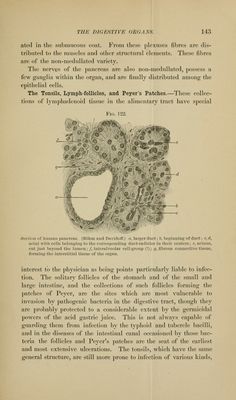
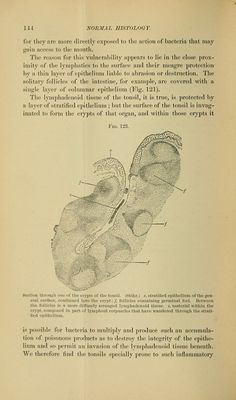
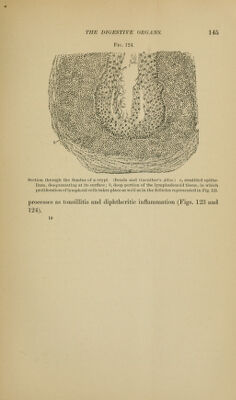
![atcd in the sulnmicous cout. From these plexuses fibres are dis- tributed to tlic museles and other structural elements. These fibres are of the non-medullated variety. The nerves of the pancreas are also non-medullated, possess a few ganglia within the organ, and are finally distributed among the epithelial cells. The Tonsils, Lymph-follicles, and Peyer's Patches.—These collec- tions of lym])hadenoid tissue in the alimentary tract have special Fk:. 122. 1^';^'^ -0 Section of Imman pancreas. (Biihrn anrl Davirtoff.) a, larger duet; b, beginning of duct; c, d, acini witli cells belonging to tlic corresponding duct-radicles in their centers; e, acinus, cut just beyond the lumen; /, interalvcolar cell-group (?); g, fibrous connective tissue, forming the interstitial tissue of the organ. interest to the physician as being points particularly liable to infec- tion. The solitary follicles of the stomach and of the small and large intestine, and the collections of such follicles forming the patches of Peyer, are the sites which are most vulnerable to invasion by pathogenic bacteria in the digestive tract, though they are probably protected to a considerable extent by the germicidal powers of the acid gastric juice. This is not always capable of guarding them from infection by the typhoid and tubercle bacilli, and in the diseases of the intestinal canal occasioned by those bac- teria the follicles and Peyer's patches are the seat of the earliest and most extensive ulcerations. The tonsils, which have the same general structure, are still more prone to infection of various kinds.](https://iiif.wellcomecollection.org/image/b21223841_0139.jp2/full/800%2C/0/default.jpg)