Histology; normal and morbid.
- Dunham, Edward K. (Edward Kellogg), 1860-1922
- Date:
- 1898
Licence: Public Domain Mark
Credit: Histology; normal and morbid. Source: Wellcome Collection.
Provider: This material has been provided by the Augustus C. Long Health Sciences Library at Columbia University and Columbia University Libraries/Information Services, through the Medical Heritage Library. The original may be consulted at the the Augustus C. Long Health Sciences Library at Columbia University and Columbia University.
179/466 page 183
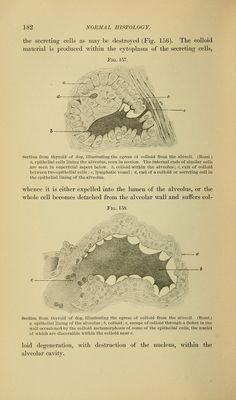
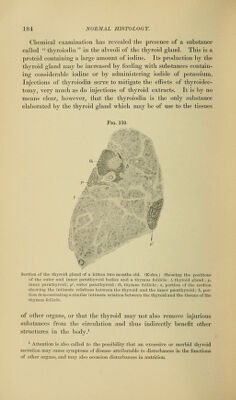
![The colloid material sLib.seqiuiitly Hiids its way into the general circulation, eitiaT by passing botwciii tlic intact cells of the alveolus (Fig. 157), or after a passage has been prepared for it through altera- tions in certain of tiiose cells (Fig. lo<S). The colloid is then taken up by the lymphatics, through which it reaches the general circula- tion. Thisjsan example of internal secretion which j)resents much of interest. It is probable that a similar, but much less obvious, process takes place in some of the ordinary secreting glands of the body, certiiin elaborated materials being returned to the circulation by the cells of the gland, while others are utilized for their nourish- ment and for the elaboration of the more obvious secretion. That the secretion of the thyroid gland is of importance to the general organism is shown by the effects of disease or removal of the gland upon the general nutrition. Total extirpation of the thyroid, together with the parathyroids, occasions the death of an animal within a few days, after symptoms of grave disturbances in the central nervous system, among which are tetanic convulsions. A partial removal of the gland, or its removal without that of the parathyroids, causes profound disturbances of nutrition, grouped under the title cachexia struraipriva. The animal becomes weak, drowsy, and emaciated ; the skin dry and scaly, with a loosening of the hairs. In young animals the growth is retarded, especially the development of the bones, through degenerative changes in the epiphysial cartilages. In these, the intercellular substance becomes swollen and disintegrated ; the cells atrophied or destroyed. Marked changes, designated as myxtedema, also appear in the su])cutaneous tissue, which is converted into a species of mucoid tissue, probably as the result of an altered metabolism within the pre-existent cells of the tissue. The functional activity of the kidney is modified; after a while, albuminuria results. Exactly similar disturbances have been observed in people suffering from disease of the thyroid gland. The foregoing facts are cited here in order to emphasize by a striking example the statement previously made, that the organs of the body are mutually dependent upon each other. Experimentation and clinical study liave further shown that the symptoms of myx(Tedema may be moderated or perhaps entirely arrested by feeding with thyroid extracts, or still more markedly by injecting extracts from thyroid glands beneath the skin, where they would speedily pass into the lymphatics and thence into the general circulation.](https://iiif.wellcomecollection.org/image/b21223841_0179.jp2/full/800%2C/0/default.jpg)