Histology; normal and morbid.
- Dunham, Edward K. (Edward Kellogg), 1860-1922
- Date:
- 1898
Licence: Public Domain Mark
Credit: Histology; normal and morbid. Source: Wellcome Collection.
Provider: This material has been provided by the Augustus C. Long Health Sciences Library at Columbia University and Columbia University Libraries/Information Services, through the Medical Heritage Library. The original may be consulted at the the Augustus C. Long Health Sciences Library at Columbia University and Columbia University.
195/466 page 199
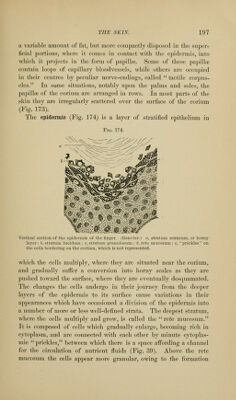
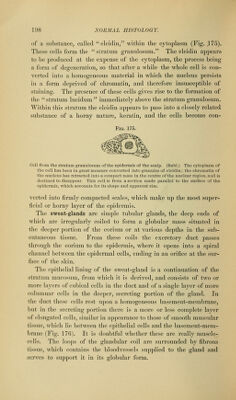
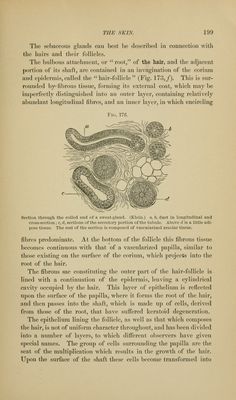
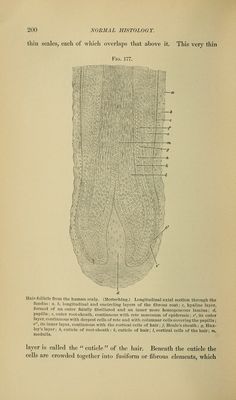
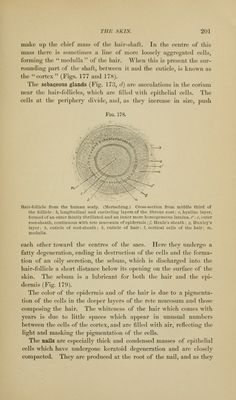
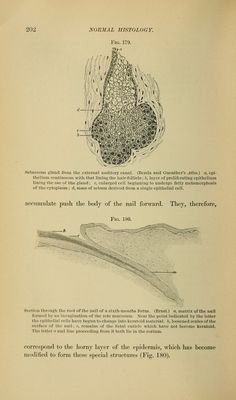
![The sebaceous glands can best be described in connection witli the hairs and tlicir follicles. The bulbous attachment, or root, of the hair, and the adjacent ])ortion of its shaft, are contained in an invafj;!nation of the corium and e[)iderinis,called the hair-follicle (Fig. 17.j,/). This is sur- rounded by-fibrous tissue, forming its external coat, which may be imperfectly distinguished into an outer layer, containing relatively abundant longitudinal fibres, and an inner layer, in which encircling lM(i. 176. Section through the coiled end of a sweat-gland. (Klein.) a, b, duct in longitudinal and cross-section ; c, d, sections of the secretory portion of the tubule. Above d is a little adi- pose tissue. The rest of the section is composed of vascularized areolar tissue. fibres predominate. At the bottom of the follicle this fibrous tissue becomes continuous with that of a vascularized papilla, similar to those existing on the surface of the corium, which projects into the root of the hair. The fibrous sac constituting the outer part of the hair-follicle is lined with a continuation of the epidermis, leaving a cylindrical cavity occu])ied by the hair. This layer of epithelium is reflected upon the surface of the papilla, where it forms the root of the hair, and then passes into the shaft, which is made up of cells, derived from those of the root, that have suffered keratoid degeneration. The epithelium lining tiie follicle, as well as that which composes the hair, is not of uniform character throughout, and has been divided into a number of layers, to which different observers have given special names. The group of cells surrounding the papilla are the seat of the multiplication which results in the growth of the hair. Upon the surface of the shaft these cells become transformed into](https://iiif.wellcomecollection.org/image/b21223841_0195.jp2/full/800%2C/0/default.jpg)