Histology; normal and morbid.
- Dunham, Edward K. (Edward Kellogg), 1860-1922
- Date:
- 1898
Licence: Public Domain Mark
Credit: Histology; normal and morbid. Source: Wellcome Collection.
Provider: This material has been provided by the Augustus C. Long Health Sciences Library at Columbia University and Columbia University Libraries/Information Services, through the Medical Heritage Library. The original may be consulted at the the Augustus C. Long Health Sciences Library at Columbia University and Columbia University.
45/466 page 49
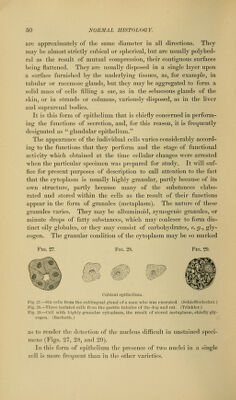
![in composition lias led to the inference that the endothelium of the capilUiry walls exercises an active function in determining what shall pass thron<ili it; that the lymph is a sort of endothelial secre- tion. It is drflicult, however, to reconcile this view with the fact that the endothelial cells are so poor in cytoplasm. Endothelium is developed from the mesoderm. II. EPITHELIUM. General Characters.—(1) The cells are nearly always large and rich in granular cytoplasm. They contain distinct round or oval, vesicular nuclei, of which there is usually only one in each cell. (2) The intercellular substance is very small in amount and is clear and homoo-encons. (3) The arrangement of the cells and their size and shape all vary greatly, giving rise to a number of varieties of epithelium, which are classified according to the slmpe and arrange- ment of the cells. In pavement-epithelium the cells are thin and arranged in a single layer, not unlike endothelium. In cubical epithelium the cells are thicker and also usually arranged in but a single layer. In columnar epitheliiuu the cells are })rismatic in form and rest with their bases u})on the surface of the tissues beneath. They are usually separated at their bases by pyramidal cells, so that the layer of epithelium cannot be said to consist strictly of but one layer of cells, and in some situations there are several distinct layers. In stratified epithelium the cells are superimposed upon each other to form a layer of cells, the thickness of which is several times the diameter of a single cell. The cells of the variety of epi- theliiuu called ciliated epithelium differ from those of the other varieties in jiossessing delicate, hair-like processes which project from the free surface of the tissue. Epithelium resembles endothelium in being com])osed almost exclusively of cells separated by a minimal amount of intercellular substance. Like endothelium, it is nearly always found covering other tissues and having one free surface. The two tissues differ greatly in the character of their cells, with one notable exception. This exception is found in the epithelial lining of the pulmonary alveoli, where the pavement-epithelium contains cells that closely resemble those of endothelium. These cells are, however, directly exposed to the inspired air, while endothelium is only found in situa- tions where it is i)rotccte(l from all contact with the external world. 1. Cubical Epithelium.—The cells of this variety of epithelium 4](https://iiif.wellcomecollection.org/image/b21223841_0045.jp2/full/800%2C/0/default.jpg)