Histology; normal and morbid.
- Dunham, Edward K. (Edward Kellogg), 1860-1922
- Date:
- 1898
Licence: Public Domain Mark
Credit: Histology; normal and morbid. Source: Wellcome Collection.
Provider: This material has been provided by the Augustus C. Long Health Sciences Library at Columbia University and Columbia University Libraries/Information Services, through the Medical Heritage Library. The original may be consulted at the the Augustus C. Long Health Sciences Library at Columbia University and Columbia University.
64/466 page 68
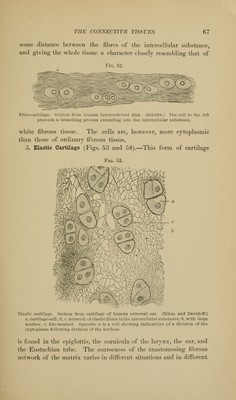
![parts of the same piece of cartilage. The reticulum is usually- more oi)en and composed of larger fibres toward the centre of the tissue than at the ])eriphery, where it becomes more delicate and finally blends with the fibrous intercellular substance of the peri- chondrium. It is evident, both from the structure of the cartilages and from the situations in which they are found, that they constitute elastic tissues suitable for diminishing the effects of mechanical shock. This is obviously the case in the joints, where both the hyaline and the fibrous varieties are found. Their elasticity and moderately firm consistency are also of obvious utility in the larynx and other air-passages and in the ear, nose, and synchondroses. II. BONE. General Characters.—(1) The cells of bone, called bone-corpus- cles, have an oval vesicular nucleus, surrounded by a moderate amount of cytoplasm, which is prolonged into delicate branching processes that join those of neighboring cells. (2) The intercellular substance is composed of an intimate association of an organic substance and salts of the earthy metals. (8) The arrangement of these constituents is as follows : the organic basis of the inter- cellular substance is arranged in laminoe, which are closely applied to each other except at certain points where there are cavities, called lacunre, giving lodgement to the bone-corpuscles. Joining these lacunre with each other are minute channels in the intercellular substances, canaliculi, which are occupied by the fine processes of the corpuscles. In the comj)act portions of the long bones, and wherever the osseous tissue is abundant, the lamina? are arranged concentrically around nutrient canals, the Haversian canals,^ which traverse the bone, anastomosing with each other and contain- ing the nutrient bloodvessels of the tissue. In cancellated bone these Haversian canals are absent, and the thin plates of bone are made up of ])arallel laminie of intercellular substance, between which are the lacunae, connected with each other by canaliculi. The bone-corpuscles are nourished from the fiuids circulating in the marrf)w, which occupies the large spaces of this spongy variety of bone. It is not possible in a single pre])aration to study even these gen- eral characters of bone. The earthy salts in the intercellular sub-](https://iiif.wellcomecollection.org/image/b21223841_0064.jp2/full/800%2C/0/default.jpg)