Histology; normal and morbid.
- Dunham, Edward K. (Edward Kellogg), 1860-1922
- Date:
- 1898
Licence: Public Domain Mark
Credit: Histology; normal and morbid. Source: Wellcome Collection.
Provider: This material has been provided by the Augustus C. Long Health Sciences Library at Columbia University and Columbia University Libraries/Information Services, through the Medical Heritage Library. The original may be consulted at the the Augustus C. Long Health Sciences Library at Columbia University and Columbia University.
75/466 page 79
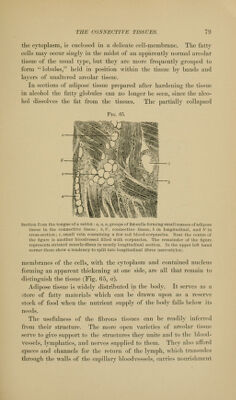
![the cytoplasm, is ciu'losetl in ii ilolicate cell-incnibrane. The fatty cells may occur singly in the midst of an apparently normal areolar tissue of the usual type, but they are more frequently grouj)ed to form '' lobulws, hold in position within the tissue by bands and layers of unaltered areolar tissue. In sections of adipose tissue prepared after hardening the tissue in alcohol the fatty globules can no longer be seen, since the alco- hol dissolves the fat from the tissues. The partially collapsed Section f:-om the tongue of a rabbit: a, a, a, groups of fat-cells forming small masses of adipose tissue in the connective tissue ; b, b', connective tissue, 6 in longitudinal, and 6' in cross-section; c, small vein containing a few red blood-corpuscles. Near the centre of the figure is another bloodvessel tilled with corpuscles. The remainder of the figure represents striated muscle-fibres in nearly longitudinal section. In the upper left hand corner these show a tendency to split into longitudinal fibres (sarcostylesi. membranes of the cells, with the cytoplasm and contained nucleus forming an apparent thickening at one side, are all that remain to distinguish the tissue (Fig. 65, a). Adipose tissue is widely distributed in the body. It serves as a store of fatty materials which can be drawn upon as a reserve stock of food when the nutrient supply of the body falls below its needs. The usefulness of the fibrous tissues can be readily inferred from their structure. The more open varieties of areolar tissue serve to give sup]>ort to the structures they unite and to the blood- ves.sels, lymphatics, and nerves sujiplied to them. They also alibrd spaces and channels for the return of the lymph, which transudes througli the walls of the capillary bloodvessels, carries nourishment](https://iiif.wellcomecollection.org/image/b21223841_0075.jp2/full/800%2C/0/default.jpg)