Volume 1
A bibliography of royal proclamations of the Tudor and Stuart sovereigns and of others published under authority, 1485-1714 / With an historical essay on their origin and use, by Robert Steele.
- James Lindsay, 26th Earl of Crawford
- Date:
- 1910
Licence: In copyright
Credit: A bibliography of royal proclamations of the Tudor and Stuart sovereigns and of others published under authority, 1485-1714 / With an historical essay on their origin and use, by Robert Steele. Source: Wellcome Collection.
43/762 page 33
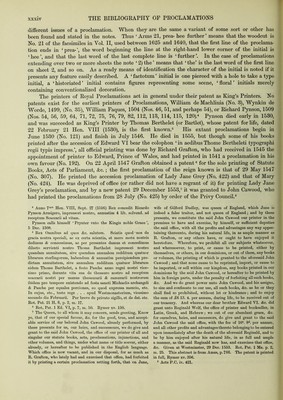
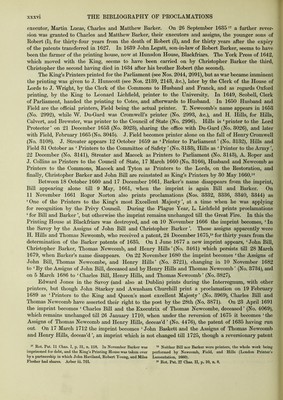
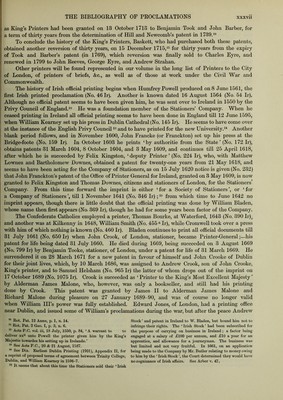
![” CHAPTER III I THE BIBLIOGRAPHY OF PROCLAMATIONS One of the main objects of this work is to afford a bibliographical description of printed ^ proclamations from the earliest date to the accession of George I. Proclamations have always been printed on one side of a sheet of paper for convenience in pasting them up, and are therefore i described as broadsides.^ The complete description of a printed proclamation as it will be found in this work consists of the following notes: (a) source; (6) title, or (c) first words and supplied title ; (d) place and date of signing; (e) place of printing, name of printers, and date of printing; (/) number of sheets, and style of type; (g) criteria for distinguishing editions of the same proclamation; (h) a precis of the contents of the proclamation; (i) a list of libraries (with press-marks) where it may be seen; (A:) a reference to the Patent Roll on which it is entered; (?) notes, if any, and a reference to any books in which it is reprinted or discussed; {m) a reference number. Normally, every proclamation opens with a statement of the person by whom it is made: ‘ By The King.’ When this does not appear it has been supplied in square brackets. In the case of I some proclamations found only in MS., the source has been supplied by the editor for the sake of uniformity, but in modern spelling. In Scotland either the term Secret Council or Privy Council has been supplied as the usage of the time seemed to point, i A proclamation usually follows the statement of its source by a title: ‘ A Proclamation for keeping of the peace in London.’ When this is not the case it is described by the first words of the , proclamation and a single line summary-title provided: [Begins] Whereas the Quenes maiestie, hath j in this . . . [Sacraments to be received in both kinds]. Occasionally the title provided is only : ‘ A Proclamation ’; in that case a summary-title is supplied. ^ I A proclamation ends with the place and date at which it was signed: ‘ Given at Our Court at ! Whitehall the 27th day of February, in the fourteenth Year of Our Reign, of England, Scotland, i France, and Ireland’; which appear thus in the description, ‘Whitehall: 27 February [1638-9]’. I The year, it will be remembered, began on 25 March in England and Ireland, and in Scotland before the year 1600. There is therefore a double year date for events falling between 1 January and 1 24 March. WTienever a single date only is given, it is referred to modern usage. The imprint of a proclamation is usually in terms such as the following : ‘ ^ Imprinted at London by Robert Barker, Printer to the Kings most excellent Majestie. And by the Assignes of John Bill, i 1638.’ This appears in the description as—‘ London ; Barker & Assigns of Bill: 1638.’ The number of sheets and the type are then stated : 2 folios (ff.). Gothic letter. In a few cases of the rarest Irish ; proclamations the depth of 10 lines of type is added to assist in identification. After 1688 some are I printed in an edition on both sides of the paper; the description then specifies pages, not folios. The ‘ criteria ’ of a proclamation, or the means by which different issues of the same proclamation I are distinguished from each other, consist first of a woodcut of the royal arms. Facsimiles of these I have been made and are referred to by number.® The distinction between simultaneous issues is ' often made most readily in this way. Proclamations are however often found with the arms : removed, and another means of identification is therefore necessary. Every proclamation has a large initial letter indented in the body of the text. It is found that if the last word of the first line of the j proclamation, the word at the lower right-hand corner of the initial, and the last word of the last j complete line of the proclamation itself be observed, it rarely occurs that they are the same in two ‘ The term ‘ single sheet ’ has been proposed, but the fact that nize the woodcuts of arms by careful measurements of the gi’eatest a proclamation may consist of as many as eleven sheets prevents length and breadth, but this method was found quite untrust- its being described as a single sheet. ‘ Placard ’ would be a useful worthy, differences of size amounting to five per cent, occurring in ' term, but it has a somewhat special meaning. impressions from the same block. The identification of the arms “ All words in square brackets are supplied by the editor. used at the end of the reign of James II and of William III has * While the work was in progress an attempt was made to recog- suffered from this cause.](https://iiif.wellcomecollection.org/image/b24872763_0001_0043.jp2/full/800%2C/0/default.jpg)



 No text description is available for this image
 No text description is available for this image
 No text description is available for this image