Experiments on the dyeing properties of lichens / by W. Lauder Lindsay.
- William Lauder Lindsay
- Date:
- [1854]
Licence: Public Domain Mark
Credit: Experiments on the dyeing properties of lichens / by W. Lauder Lindsay. Source: Wellcome Collection.
Provider: This material has been provided by The Royal College of Surgeons of England. The original may be consulted at The Royal College of Surgeons of England.
12/42 page 12
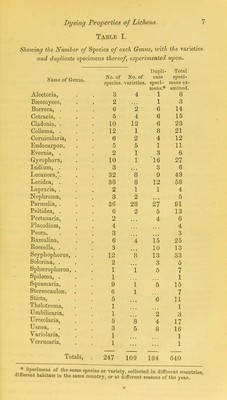
![Table III. Showing the Species and Varieties the Alcoholic Solution* of which gives a red-]- reaction with Solution of Chloride of Lime. J Name of Lichen. Fugitive. LiSht DeeP ° tint. tint. Borrera furfuracea, Coi^nicularia aculeata ? Endocarpon Hedwigii, Evernia Prunastri, Gyrophora deusta, erosa, Brown. Cherry. Blood. } — Cherr Cherry. murina, 3 specimens from Switzer- 1 ~, , land, Norway, and Scotland, ] Gherry« Cherry- Blood- hirsuta, 3 specimens from Swit- zerland and France, hyperborea, 2 specimens from Do. pellita, 3 specimens from Scotland 1 p, and France, . . .J ieuy- Onerry. polyphylla, 4 specimens from Eng- 1 land, France, and Switzerland, J proboscidea, 3 specimens fromNor- | Blood way, France, and Scotland, J vellea, .... Cherry. — Lecanora coenisia, . — glaucoma, .... — parella var. albo-flavescens, Cherry. Cherry. tartarea, 3 specimens from Scotland, 1 n. , , t? j q *. i I ' > rink. Blood. Jb ranee, and bwitzerland, Lecidea atro-pruinosa, var. microphylla, Cherry. * This merely means the result of boiling the comminuted lichen in weak spirit. It may be considered a solution of the colorific principles of the plant, as most of these are soluble in alcohol. t This term includes light and dark shades of— a. yellowish or orange red. b. brownish-red, such as sherry and claret colours. c. cherry, blood, or pinkish red. The above list includes the greater number of the species useful as dye-agents. Most of them will be found to yield on ammoniacal maceration, rich red or purple tints, but not uniformly. (Vide Table xiii.) | A solution of common bleaching powder. The active ingredient is probably the hypochlorite of lime it contains; so that, so far as concerns its use as a colorific test, this solution may be considered one of hypochlorite of lime.](https://iiif.wellcomecollection.org/image/b22285349_0014.jp2/full/800%2C/0/default.jpg)