The toxic amblyopias: their classification, history, symptoms, pathology, and treatment.
- George Edmund de Schweinitz
- Date:
- 1896
Licence: Public Domain Mark
Credit: The toxic amblyopias: their classification, history, symptoms, pathology, and treatment. Source: Wellcome Collection.
Provider: This material has been provided by the Harvey Cushing/John Hay Whitney Medical Library at Yale University, through the Medical Heritage Library. The original may be consulted at the Harvey Cushing/John Hay Whitney Medical Library at Yale University.
213/262 page 197
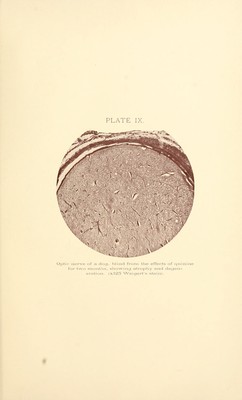
![ciliary nerves and slight degenerative changes in the ganglion itself. A section of a normal ganglion stained by Weigert's process compared with the ganglion from the quinine specimen, prepared by exactly the same process, illustrates the degeneration in the fibres. Transverse sections of the chiasm compared with similar sections taken from the normal dog make it evident that the degenerative process and complete atrophy exist in all of the fibres up to the chiasm, in the chiasm itself, as far backward as it has been possi- ble to trace the optic tracts. The dilatation of the pericellular lymph-spaces through the brain in the first series, especially in the cuneus, has been shown by a number of experiments to be unconnected with any action of quinine, being easily ]3roduced by any slight fault in the technique. In rSsmnS I may say in regard to the microscopical appearances, that there are thickening and changes in the walls of the optic-nerve vessels (endovasculitis) ; organ- ization of a clot, the result of thrombosis, an organization which has been carried on even to the extent of its being channelled by new vessels ; widening of the infundibulum of the vessels as the result of the constriction of the sur- rounding nerve fibres, causing appearances not unlike a glaucomatous excavation; and, finally, practically com- plete atrophy of the visual path, including the optic nerves, optic chiasm, and optic tracts, as far as they could be traced. It seems, then, very likely that the original effect of quinine is upon the vasomotor centres, producing con- striction of the vessels ; that finally changes in the vessels themselves are set up, owing to an endo vasculitis ; that thrombosis may occur, and that the result of all of these is an extensive atrophy of the visual tract.](https://iiif.wellcomecollection.org/image/b21027754_0213.jp2/full/800%2C/0/default.jpg)

 No text description is available for this image
 No text description is available for this image
 No text description is available for this image