Outline of physiological chemistry, including the qualitative and quantitative analysis of the tissues fluids and excretory products / by Charles Henry Ralfe.
- Charles Henry Ralfe
- Date:
- 1873
Licence: Public Domain Mark
Credit: Outline of physiological chemistry, including the qualitative and quantitative analysis of the tissues fluids and excretory products / by Charles Henry Ralfe. Source: Wellcome Collection.
Provider: This material has been provided by The University of Leeds Library. The original may be consulted at The University of Leeds Library.
31/280
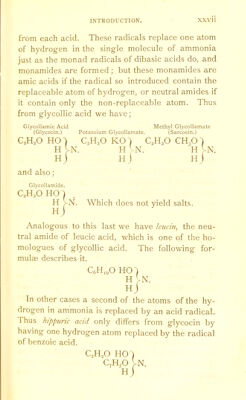
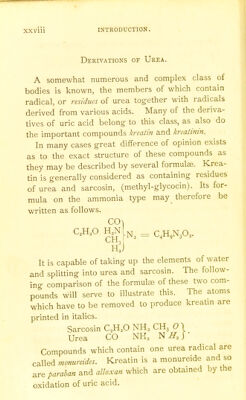
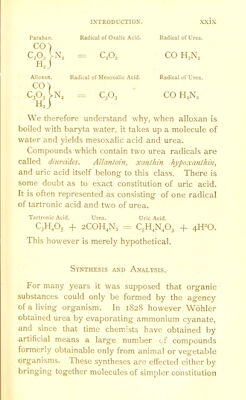
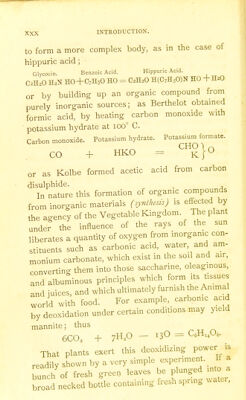
![from each acid. These radicals replace one atom of hydrogen in the single molecule of ammonia just as the monad radicals of dibasic acids do, and monamides are formed; but these monamides are amic acids if the radical so introduced contain the replaceable atom of hydrogen, or neutral amides if it contain only the non-replaceable atom. Thus from glycollic acid we have; Glycollamic Acid Methyl Glycollamate (Glycocin.) Potassium Glycollamate. (Sarcosin.) CM.O HO) CM.O KO) aH,0 CH3O) H VN. H -N. H VN. hJ hJ hJ and also; Glvcollamide. C,H,'OHO] H VN. Which does not yield salts. Hj Analogous to this last we have ktta'n, the neu- tral amide of leucic acid, which is one of the ho- mologues of glycollic acid. The following for- mulae describes it. CfiH.oO HO) H VN. Hj In other cases a second of the atoms of the hy- drogen in ammonia is replaced by an acid radical. Thus hippttric acid only differs from glycocin by having one hydrogen atom replaced by the radical of benzoic acid. QH,0 HO' C,HjO H j In.](https://iiif.wellcomecollection.org/image/b21509566_0031.jp2/full/800%2C/0/default.jpg)
 No text description is available for this image
 No text description is available for this image
 No text description is available for this image