Volume 1
A text-book of surgery / by Hermann Tillmanns ; translated from the 3rd [and 4th] German edition by John Rogers and Benjamin T. Tilton.
- Tillmanns, Hermann, 1844-1927. Lehrbuch der allgemeinen Chirurgie. English
- Date:
- 1895-1898
Licence: Public Domain Mark
Credit: A text-book of surgery / by Hermann Tillmanns ; translated from the 3rd [and 4th] German edition by John Rogers and Benjamin T. Tilton. Source: Wellcome Collection.
23/840 page 11
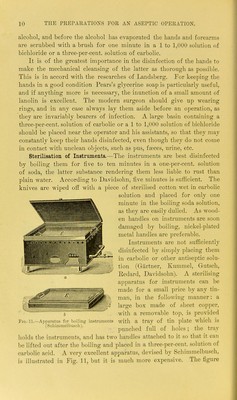
![§6.] needs no explanation. At the close of the process of sterilisation the wire tray which holds the instruments, is taken out and placed in a three-per-cent. carbolic solution contained in a glass dish or tray made of enamel-covered metal. Before using, I generally wipe off every knife carefully with a piece of sterilised cotton moistened in a three-per-cent. solution of carbolic acid. This is a mechanical means of disinfection which Gartner has shown to be particularly efficacious. During the operation the instruments should lie in an antiseptic solution, preferably a three-per- cent, solution of carbolic. For this purpose trays are used made of glass, porcelain, and metal. The non-breakable and easily cleaned vessels of enamelled metal which are used in the kitchen are very good for this purpose. After every operation the instruments are scrubbed with a brush and soap in a three-per-cent. solution of carbolic acid and then polished. Amongst the other sterilising apparatus, those devised by Braatz, Kronacher, Sternberg, and Mehler should be mentioned. For sponging the wound during the operation, sterilised pledgets of cotton wool or gauze pads should be used, and these are kept wrapped up in sterilised gauze; they are made germ-free by sterilisation at a tem- perature of 100° to 130° C. (212° to 266° F.) for half an hour, and are decidedly preferable to the ordinary sponges which were formerly em- ployed, as the pads are only used to wipe out the wound once and are afterwards burnt. A large stock of such sterilised gauze pads can be always kept on hand in a bichloride solution (1 to 1,000), or only freshly sterilised pads can be used. Disinfection of Sponges.—Ordinary sponges very quickly become use- less after sterilisation in the hot steam of a steriliser, and they are best disinfected in the following way': After pounding them thoroughly, rinse them in a solution of potassium permanganate (1 to 500-1,000), then soak them for a quarter of an hour in a solution consisting of four fifths to one per cent, of hyposulphite of soda and from one fifth to eight per cent, of pure hydrochloric acid (Keller); then place them for a quarter of an hour more in boiling water or in a boiling soda solution of a strength of one per cent. The sponges are stored in a five-per-cent. solution of carbolic acid or one-tenth per-cent. solution of bichloride of mercury. Sterilisation of Dressings, Silk, Catgut.—Silk, catgut, drainage-tubes, dressings, and bandages should also be rendered perfectly sterile. Silk should be 15oiled for half an hour in a bichloride solution (2. to 1,000) or a five-per-cent. carbolic solution, and the other materials can be treated by dry sterilisation—i. e., by keeping them in the dry steril-](https://iiif.wellcomecollection.org/image/b20421035_0001_0023.jp2/full/800%2C/0/default.jpg)
 No text description is available for this image
 No text description is available for this image
 No text description is available for this image