Volume 1
A text-book of surgery / by Hermann Tillmanns ; translated from the 3rd [and 4th] German edition by John Rogers and Benjamin T. Tilton.
- Tillmanns, Hermann, 1844-1927. Lehrbuch der allgemeinen Chirurgie. English
- Date:
- 1895-1898
Licence: Public Domain Mark
Credit: A text-book of surgery / by Hermann Tillmanns ; translated from the 3rd [and 4th] German edition by John Rogers and Benjamin T. Tilton. Source: Wellcome Collection.
24/840 page 12
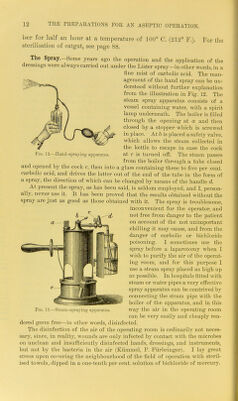
![Fig. 12.—Hand-spraying apparatus. iser for half an hour at a temperature of 100° C. (212° F.). For the sterilisation of catgut, see page 88. The Spray.—Some years ago the operation and the application of the dressings were always carried out under the Lister spray—in other words, in a fine mist of carbolic acid. The man- agement of the hand spray can be un- derstood without further explanation from the illustration in Fig. 12. The steam spray apparatus consists of a vessel containing water, with a spirit lamp underneath. The boiler is filled through the opening at a and then closed by a stopper which is screwed in place. At 6 is placed a safety valve, which allows the steam collected in the kettle to escape in case the cock at c is turned oflp. The steam passes from the boiler through a tube closed and opened by the cock c, then into a glass containing three to five per cent, carbolic acid, and drives the latter out of the end of the tube in the form of a spray, the direction of which can be changed by means of the handle d. At present the spray, as has been said, is seldom employed, and I, person- ally, never use it. It has been proved that the results obtained without the spray are just as good as those obtained with it. The spray is troublesome, inconvenient for the operator, and not free from danger to the patient on account of the not unimportant chilling it may cause, and from the danger of carbolic or bichloride poisoning. I sometimes use the spray before a laparotomy when I wish to purify the air of the operat- ing room, and for this purpose I use a steam spray placed as high up as possible. In hospitals fitted with steam or water pipes a very effective spray a])paratus can be contrived by connecting the steam pipe with the boiler of the apparatus, and in this way the air in the operating I'oom can be very easily and cheaply ren- dered germ free—in other words, disinfected. The disinfection of the air of the operating room is ordinarily not neces- sary, since, in reality, wounds are only infected by contact with the microbes on unclean and insufficiently disinfected hands, dressings, and instruments, but not by the bacteria in the air (Kiimmel, P. PXirbringer). I lay great stress upon covering the neighbourhood of the field of opei'ation with stcril- i.sed towels, dipped in a one-tenth per cent, solution of bichloride of mercury. Fio. 13.—Steam-spraying apparatus.](https://iiif.wellcomecollection.org/image/b20421035_0001_0024.jp2/full/800%2C/0/default.jpg)
 No text description is available for this image
 No text description is available for this image
 No text description is available for this image