Volume 1
A text-book of surgery / by Hermann Tillmanns ; translated from the 3rd [and 4th] German edition by John Rogers and Benjamin T. Tilton.
- Tillmanns, Hermann, 1844-1927. Lehrbuch der allgemeinen Chirurgie. English
- Date:
- 1895-1898
Licence: Public Domain Mark
Credit: A text-book of surgery / by Hermann Tillmanns ; translated from the 3rd [and 4th] German edition by John Rogers and Benjamin T. Tilton. Source: Wellcome Collection.
90/840 page 78
![mercury. To bring the mercury more thoroughly into contact with the zinc, it is rubbed into the plates of the latter with a tooth-brush or coarse paper. Battery of Bruns.—The zinc-carbon chromic-acid battery of Bruns is an excellent apparatus. Sailer's Battery.—Seiler has also introduced a new form of battery for the galvano-cautery. It consists of zinc-carbon elements in a fluid made of a mixture of sulphuric acid and bichromate of potassium; the elements are im- mersed in the fluid by turning a crank connected with a pedal. The opera- tor keeps his foot upon this during the operation, and, by exerting more or less pressui-e with his foot, can regulate the strength of the current. To protect the surrounding parts from injury while the cautery is heated, Seiler has sheathed the part of his cautery instrument not intended to become red- hot, and the connecting wires in vulcanised rubber. The present rapid advance in electricity enables us to make direct use of the electric current without using a battery; surgery will soon make use of this modern acquisition also, and thus electrolysis will have a new field opened up for itself. All wound surfaces made by the cautery bleed but little or not at all, and are thus in a manner protected from infection, as the micro- organisms present at the time are destroyed, and the resulting dry eschar is an unfavourable soil for the lodgment of new ones. Moreover, wounds made by burning granulate vigorously, heal quickly, and form a cicatrix which has a marked tendency to contract. Suppuration does not always occur, and often enough wounds of this kind heal beneath the eschar with no dressing and without noticeable suppuration. Electro-puncture (Electrolysis).—The so-called galvano-puncture or electro-puncture (electrolysis) is but little used at present. It consists in inserting platinum or gold needles, which are connected with the poles of a strong battery, directly into the tissue but not too far apart. The changes thus induced in the tissues are limited to the immediate neigh- bourhood of the needles. In other cases only a single platinum needle connected with the anode or cathode is inserted into the tissues in ques- tion—for instance, into a tumour—and a metal plate connected with the other pole is placed upon the skin. The negative pole (the cathode) appears to have a more powerful action than the positive (the anode). Recently electrolysis has come into more frequent use for o]?erative purpo.ses, especially in the case of tumours which are difficult of access, like naso-pharyngeal tumours, fibromata of the uterus, etc. In gyniE- cology the electrical treatment of women's diseases inaugurated by Apostoli has occasionally produced surprising results. I agree with Kuttner, that under certain conditions electrolysis ofl'ers us hojies of success, by being applicable to deeply seated regions when other means fail entirely.](https://iiif.wellcomecollection.org/image/b20421035_0001_0090.jp2/full/800%2C/0/default.jpg)
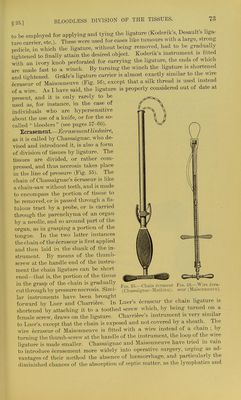
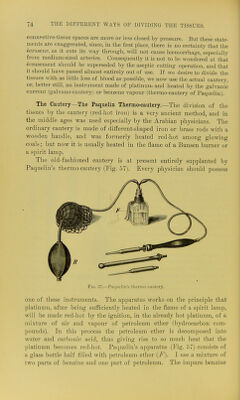
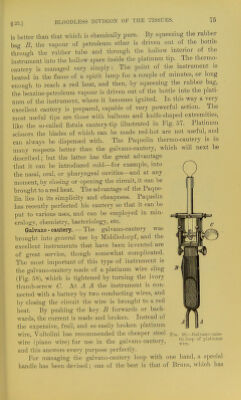
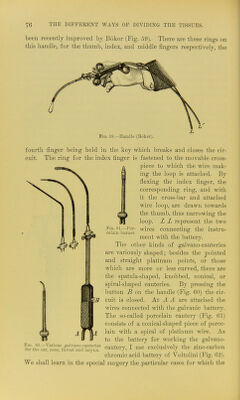
 No text description is available for this image
 No text description is available for this image
 No text description is available for this image