Studies on pneumonic plague and plague immunization / by Richard P. Strong and Oscar Teague.
- Richard P. Strong
- Date:
- [date of publication not identified]
Licence: Public Domain Mark
Credit: Studies on pneumonic plague and plague immunization / by Richard P. Strong and Oscar Teague. Source: Wellcome Collection.
9/70 page 258
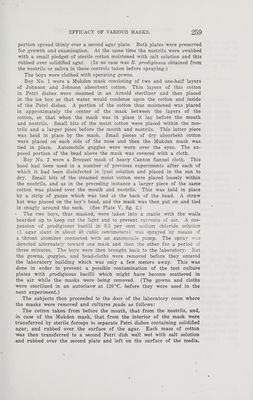
![was boarded up on all sides to keep out the light and to avoid, to a certain extent, currents of air. The gowns, goggles, and head-cloths were removed after the subjects had left the stable and before they entered the laboratory building. One of the authors attended to the spraying and exposure of the subjects, the other endeavored to keep himself and his laboratory room free from B. prodigiosus and made the necessary plate-cultures in order to determine the result of the test. At first the saliva, taken before and after the spraying, was smeared over agar plates, but later it was found that small pieces of moistened cotton, placed in the nostrils and before the mouth (underneath the Mukden mask), rendered the test much more delicate. Agar plates were exposed during the course of the experiment in order to obtain ‘an indication of the living prodigiosus bacilli that were in the air around the mask at that time. The following protocols, selected from a long series of such experiments, demonstrate the general mode of procedure and the results obtained. PROTOCOL NO. i. (EXPERIMENT NOS. 97 AND 98.) Two laboratory boys* served as subjects. Control] plates were made as follows: A quantity of saliva was expectorated into a plate containing solidified agar, distributed by means of a sterile-cotton plug, and a small *The first experiment was performed upon ourselves to demonstrate the harmlessness of the procedure. Then several of our colleagues and about 8 different laboratory boys served as subjects. in these experiments. Yet, owing to the large number of experiments that were done, it was found necessary to use the same laboratory boys repeatedly as subjects. However, a period of at least a week was allowed to elapse before a boy was again called upon to serve, and then smears were made from nostrils and saliva to determine whether by any chance Bacillus prodigiosus was present. These tests proved to be in every case negative. In order to gain some idea of the length of time that Bacillus prodigiosus can persist in the mouth, one of us rinsed his mouth with a suspension of prodigiosus (one slant in 10 cubic centimeters of salt solution) and gargled some of the same suspension. Plates inoculated with his saliva at intervals gave the following results: Saliva after three-fourths hour Plate No. 1: Overgrown with prodigiosus. : Plate No. 1: Overgrown with prodigiosus. liv 1 Pea hee haute |Plate No. 1: Overgrown with prodigiosus. Saliva after 54 hours Plate No. 1: Overgrown with prodigiosus. , Plate No. 1: 20 colonies of prodigiosus. Sal f 16 h ee a ee |Plate No. 2: 15 colonies of prodigiosus. a ee Cree [Plate No. 1: No colonies of prodigiosus.. Plate No. 2: No colonies of prodigiosus., Two meals were taken during the course of this experiment.](https://iiif.wellcomecollection.org/image/b33453056_0009.jp2/full/800%2C/0/default.jpg)
 No text description is available for this image
 No text description is available for this image
 No text description is available for this image