An examination of the Report of the Commissioners to enquire into the mortality of the Army / by Alfred Aspland.
- Alfred Aspland
- Date:
- [1859]
Licence: Public Domain Mark
Credit: An examination of the Report of the Commissioners to enquire into the mortality of the Army / by Alfred Aspland. Source: Wellcome Collection.
Provider: This material has been provided by The Royal College of Surgeons of England. The original may be consulted at The Royal College of Surgeons of England.
15/40 (page 15)
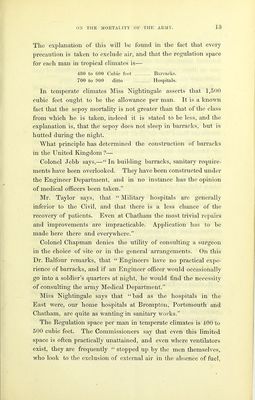
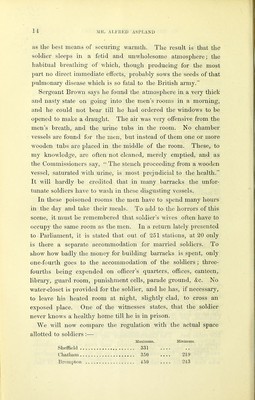
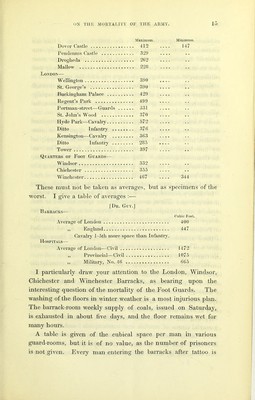
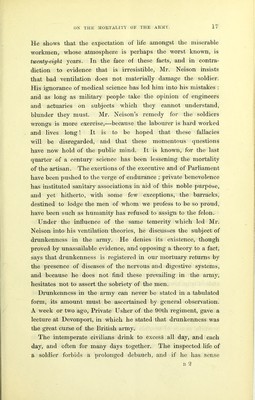
![Dover Castle Maximum. Minimum. 147 Pendenms Castle .... 329 Drogheda 262 Mallow London— Wellington «... St. George’s 390 Buckingham Palace 429 Regent’s Park Portman-street—Guards .. 331 St. John’s Wood .... 370 Hyde Park—Cavalry .... 572 Ditto Infantry .... 376 Kensington—Cavalry .... Ditto Infantry .... 285 Tower .... 397 Quarters of Foot Guards— Windsor 332 . . Chichester 355 . . Winchester .... 467 344 These must not be taken as averages, but as specimens of the worst. I give a table of averages :— [Dr. Guy.] Barracks— Cubic Feet. Average of London 400 „ England 447 Cavalry l-5th more space than Infantry. Hospitals— Average of London—Civil 1472 „ Provincial—Civil 1075 ,, Military, No. 46 665 I particularly draw your attention to the London, Windsor, Chichester and Winchester Barracks, as bearing upon the interesting question of the mortality of the Foot Guards. The washing of the floors in winter weather is a most injurious plan. The barrack-room weekly supply of coals, issued on Saturday, is exhausted in about five days, and the floor remains wet for many hours. A table is given of the cubical space per man in various guard-rooms, but it is of no value, as the number of prisoners is not given. Every man entering the barracks after tattoo is](https://iiif.wellcomecollection.org/image/b22348670_0017.jp2/full/800%2C/0/default.jpg)