Manual of pathology. Containing the symptoms, diagnosis, and morbid characters of diseases: together with an exposition of the different methods of examination, applicable to affections of the head, chest, & abdomen / Translated, with notes and additions, by Jones Quain.
- Louis Martinet
- Date:
- 1829
Licence: Public Domain Mark
Credit: Manual of pathology. Containing the symptoms, diagnosis, and morbid characters of diseases: together with an exposition of the different methods of examination, applicable to affections of the head, chest, & abdomen / Translated, with notes and additions, by Jones Quain. Source: Wellcome Collection.
45/406 page 5
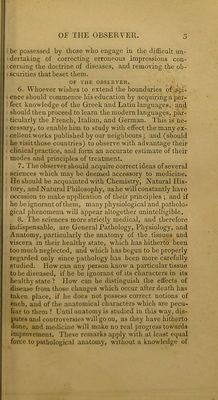
![n can he derive any advantage from the facts which lie I collects 1 or how can his reports be ever considered as (exact descriptions of the diseases he has seen 1 A state- rment of a case can never be useful to him who makes it, or profitable to science, unless it be a faithful transcript of the phenomena which have occurred. For if itbe not correct in all its parts, it will but mislead the judgment .and confirm error ; whilst exact facts, on the contrary, I > strengthen the judgment, and contribute to the esta- :blishment of an exact science. 13. When such results as these follow from the mere ■ f fact of the observer’s knowledge being inadequate, what must be the consequence, if it be but a mass of falsity I and error 1 Instead of transcribing a faithful history of the diseases presented to him, he will give an incorrect and inadequate account of them, and the only result of his observations will be, to lead to false theories, which iimay be considered as so many pathological romances that have long retarded, and still retard the progress of ' Medicine. Even under the most favourable circum- ■ stances, such a person can only attain an imperfect mode t of examination ; the degree of its imperfection will of |c :ourse be lessened in proportion as he acquires a better uknowledge of pathology, or has opportunities of observ- I' ng, and reflecting on, the facts collected by others; Jaence we can generally form an estimate, on reading a |c :ase, of the degree of knowledge possessed by the per- p ion who has detailed it. I 14. But these are not the only sources of error to be E juarded against. It will be found necessary to review t mch reports and observations as had been made during p-he earlier years of study, which are generally incorrect 5 3r incomplete. This is not done for the purpose of sup- ) flying their deficiencies, or correcting their errors, but -n order to guard against any erroneous impressions ■ diey may have left on the mind ; impressions which, in :oo many instances, have exerted an injurious influence ijn the whole course of men’s professional career. 1J Correctness and discrimination are (]ualities iiidis- n 2](https://iiif.wellcomecollection.org/image/b22024098_0045.jp2/full/800%2C/0/default.jpg)


 No text description is available for this image
 No text description is available for this image
 No text description is available for this image