A practical treatise on the diseases of the sexual organs of women / by F.W. von Scanzoni ... Tr. from the French of Drs. H. Dor and A. Socin, and annotated ... by Augustus K. Gardner.
- Friedrich Wilhelm Scanzoni von Lichtenfels
- Date:
- [1861]
Licence: Public Domain Mark
Credit: A practical treatise on the diseases of the sexual organs of women / by F.W. von Scanzoni ... Tr. from the French of Drs. H. Dor and A. Socin, and annotated ... by Augustus K. Gardner. Source: Wellcome Collection.
Provider: This material has been provided by the Harvey Cushing/John Hay Whitney Medical Library at Yale University, through the Medical Heritage Library. The original may be consulted at the Harvey Cushing/John Hay Whitney Medical Library at Yale University.
59/684 page 53
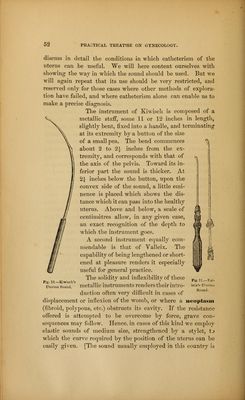
![Simpson's, which differs not materially from that of Kiwisch. To which of these gentlemen the credit of originality is due, we do not pretend to decide, although we have always been led to suppose that the great Scotchman was the inventor. We have long been in the habit of using metallic sounds made of flexible metal, as of pure copper, which may or may not be silvered, and admit of frequent bending in any direction, in those cases where from flexions or any abnormality, the ordinary sound cannot be easily passed. We have found, in using flexible bougies and catheters with or without a stylet, that we have been deceived in their supposed advance, and that in reality they did but bend upon themselves, sometimes the point re- appearing at the external os, and frequently the catheter being found doubled upon itself, and seriously flexed or broken when withdrawn. A costly and complicated instrument is Sanger's sound, which has no special utility for diagnosis, but may be of some value in restoring the abnormal positions.] This is the manner of introducing the uterine sound. The position of the patient is the same as that employed for explo- ration by the speculum. The index finger of one hand is intro- duced into the vagina in such a manner that its extremity touches with its palmar surface the neck of the uterus. While it is there maintained upon the posterior lip of the orifice, the sound is passed in with its concavity upward, just to the entrance of the neck, taking care that it remains ever in con- tact with the pulp of the conducting finger. When the orifice is a little open the point of the instrument easily penetrates into the inferior part of the cavity of the neck. However, even with virgins, its introduction between the lips of the neck by a hand somewhat accustomed is without severe difficulty. As soon as it is evident that the first part of the operation has been effected, we next try with precaution to advance the end of the sound. It is always necessary to act with management, to withdraw at the least resistance, gently to raise or lower the instrument to make its extremity penetrate into the cavity of the body of the organ. The transversal folds of the mucous membrane and the narrowness of the canal at the extremity of the internal orifice, offer a certain resistance at this step of the operation. But as soon as the tip of the sound has passed](https://iiif.wellcomecollection.org/image/b21005096_0059.jp2/full/800%2C/0/default.jpg)
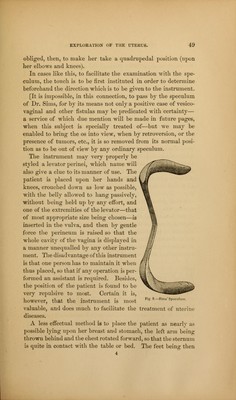
 No text description is available for this image
 No text description is available for this image
 No text description is available for this image