First report of the commissioners appointed to inquire whether any and what special means may be requisite for the improvement of the health of the metropolis : with minutes of evidence.
- Great Britain. Metropolitan Sanitary Commission
- Date:
- 1848
Licence: Public Domain Mark
Credit: First report of the commissioners appointed to inquire whether any and what special means may be requisite for the improvement of the health of the metropolis : with minutes of evidence. Source: Wellcome Collection.
Provider: This material has been provided by King’s College London. The original may be consulted at King’s College London.
22/460 page 2
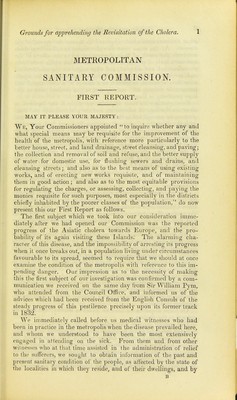
![Enquiry as to the Measures adopted other circumstances which appeared to favour the spread of the disease. At the same time we endeavoured to collect from these witnesses the result of their observations as to the effects of the measures both of prevention and of alleviation which were then recommended and adopted, and what might be the modifications and extensions suggested by subsequent reflection on the experi- ence then obtained, in relation to a disease of a most mortal and intractable nature, and entirely new to the medical men at that time practising in England. Concurrently with these inquiries we made it our business to ascertain the state of information and the practical skill and com- petence, as exemplified in their works, of the authorities charged with the direction of what all previous inquirers had agreed in representing as the chief means of prevention ; namely, the works of drainage and cleansinof. With this view we have examined the chief paid officers^ as being the persons necessarily in possession of the greatest amount of practical knowledge and skill, of all those Commissions of Sewers for the appointment and constitution of which, the Lord Chancellor, and the Lord Treasure;- of Eng- land, and the two Chief Justices for the time being, or three of them whereof the Lord Chancellor to be one, are constitutionally responsible. The evidence contained in extensively circulated official Keports on the sanitary condition of the population has now been before these Commissions several years. That evidence had displayed the sources of excessive disease and of premature mortality; and had elucidated the principles and demonstrated the practicability of large measures of prevention. We directed our inquiries to ascertain whether those principles had been duly recognised, and whether any and what attempts had been made to apply them by those administrative bodies within the range of discretionary power entrusted to them for the repression of evils which were found to be so widely s])read and so grievous; whether those bodies appeared to comprehend, and, from the works which they have executed and have now in pre- paration, were competent to carry out such measures as would satisfy the public wants, and more especially w hat amount of ser- vice might reasonably be expected through them to meet the im- pending pestilence. On these inquiries we have to report as follows; and first with respect to the cholera. Our earliest inquiry with reference to the cholera was to ascer- tain the measures which had been adopted to prevent the introduc- tion and extension of this disease when it first a])proached our shores, and whether there were any and what conclusion'^ to be deduced Ibr future guidance from the experience of those measures. We find that the first acts of the Government were to appoint, by order of the Privy Council, a Central Board of Health in](https://iiif.wellcomecollection.org/image/b21296935_0022.jp2/full/800%2C/0/default.jpg)