Licence: Public Domain Mark
Credit: The Edinburgh new dispensatory ... / by Andrew Duncan. Source: Wellcome Collection.
50/868
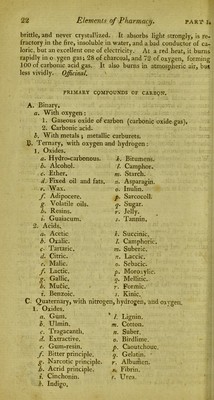
![brittle, and never crystallized. It absorbs light strongly, is re- fractory in the fire, insoluble in water, and a bad conductor of ca- loric, but an excellent one of electricity. At a red heat, it burns rapidly in o ygen gas; 28 of charcoal, and 72 of oxygen, forming 100 of carbonic acid gas. It also burns in atmospheric air, but less vividly. Officinal. PRIMARY CQMPOUNDS OF CARBON. A. Binary. a. With oxygen: 1. Gaseous oxide of carbon (carbonic oxide gas}. 2. Carbonic acid. h. With metals ; metallic carburets. B. Ternary, with oxygen and hydrogen : ]. Oxides. a. Hydro-carbonous. k. Bitumens. b. Alcohol. /. Camphor. c. Ether. m. Starch. d. Fixed oil and fats. n. Asparagin, e. Wax. o. Inulin. f Adipocere. p. Sarcocoll. g Volatile oils. q. Sugar. h. Resins. r. Jelly. i. Guaiacum. s. Tannin. . Acids. a. Acetic k. Succinic. b. Oxalic. /. Camphoric. c- Tartaric. m. Suberic. d. Citric. n. Laccic. e. Malic. o. Sebacic. f. Lactic. p. Moroxylic. g. Gallic, q. Mellitic. h. MuCic. r. Formic. i. Benzoic. s. Kinic. Quaternary, with nitrogen, hydrogen, and . Oxides. a. Gum. /, Lignin. b. Ulmin. m. Cotton. c. Tragacanth. n. Suber. d. Extractive. o. Birdlime. c. Gum-resin. p. Caoutchouc. f. Bitter principle. q. Gelatin. * g. Narcotic principle. r. Albumen. b. Acrid principle. s. Fibrin. i. Cinchonin. t. Urea. h. Indigo.](https://iiif.wellcomecollection.org/image/b22038632_0050.jp2/full/800%2C/0/default.jpg)


 No text description is available for this image
 No text description is available for this image
 No text description is available for this image