Signalling through space without wires : being a description of the work of Hertz & his successors / by Oliver J. Lodge.
- Oliver Lodge
- Date:
- [1900]
Licence: Public Domain Mark
Credit: Signalling through space without wires : being a description of the work of Hertz & his successors / by Oliver J. Lodge. Source: Wellcome Collection.
Provider: This material has been provided by the Francis A. Countway Library of Medicine, through the Medical Heritage Library. The original may be consulted at the Francis A. Countway Library of Medicine, Harvard Medical School.
43/180 (page 33)
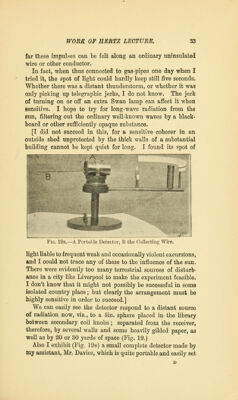
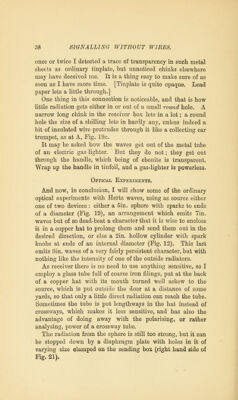
![far these impulses can be felt along an ordinary uninsulated wire or other conductor. In fact, when thus connected to gas-pipes one day when I tried it, the spot of light could hardly keep still five seconds. Whether there was a distant thunderstorm, or whether it was only picking up telegraphic jerks, I do not know. The jerk of turning on or off an extra Swan lamp can affect it when sensitive. I hope to try for long-wave radiation from the Bun, filtering out the ordinary well-known waves by a black- board or other sufficiently opaque substance. [I did not succeed in this, for a sensitive coherer in an outside shed unprotected by the thick walls of a substantial building cannot be kept quiet for long. I found its spot of Fig. 19b.—A Portable Detector, B the Collecting Wire. light liable to frequent weak and occasionally violent excursions, and I could not trace any of these to the influence of the sun. There were evidently too many terrestrial sources of disturb- ance in a city like Liverpool to make the experiment feasible. I don't know that it might not possibly be successful in some isolated country place; but clearly the arrangement must be highly sensitive in order to succeed.] We can easily see the detector respond to a distant source of radiation now, viz., to a 5in. sphere placed in the library between secondary coil knobs; separated from the receiver, therefore, by several walls and some heavily gilded paper, as well as by 20 or 30 yards of space (Fig. 19.) Also I exhibit (Fig„ 19b) a small complete detector made by my assistant, Mr. Davies, which is quite portable and easily set](https://iiif.wellcomecollection.org/image/b21064660_0043.jp2/full/800%2C/0/default.jpg)