Signalling through space without wires : being a description of the work of Hertz & his successors / by Oliver J. Lodge.
- Oliver Lodge
- Date:
- [1900]
Licence: Public Domain Mark
Credit: Signalling through space without wires : being a description of the work of Hertz & his successors / by Oliver J. Lodge. Source: Wellcome Collection.
Provider: This material has been provided by the Francis A. Countway Library of Medicine, through the Medical Heritage Library. The original may be consulted at the Francis A. Countway Library of Medicine, Harvard Medical School.
48/180 (page 38)
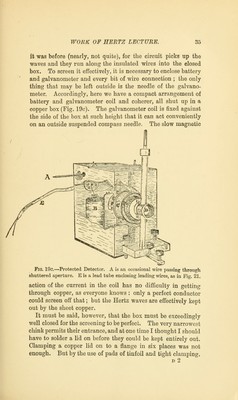
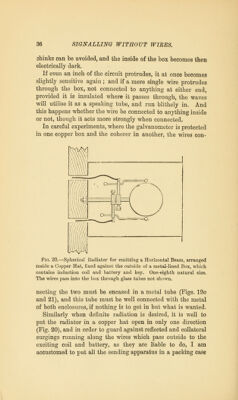
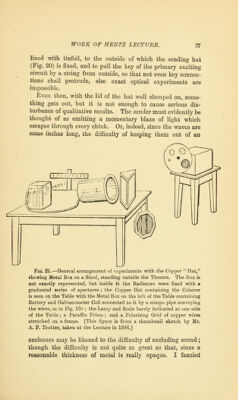
![once or twice I detected a trace of transparency in such metal sheets as ordinary tinplate, but unnoticed chinks elsewhere may have deceived me. It is a thing easy to make sure of as soon as I have more time. [Tinplate is quite opaque. Lead paper lets a little through.] One thing in this connection is noticeable, and that is how little radiation gets either in or out of a small round hole. A narrow long chink in the receiver box lets in a lot; a round hole the size of a shilling lets in hardly any, unless indeed a bit of insulated wire protrudes through it like a collecting ear trumpet, as at A, Fig. 19c. It may be asked how the waves get out of the metal tube of an electric gas lighter. But they do not; they get out through the handle, which being of ebonite is transparent. Wrap up the handle in tinfoil, and a gas-lighter is powerless. Optical Experiments. And now, in conclusion, I will show some of the ordinary optical experiments with Hertz waves, using as source either one of two devices : either a 5in. sphere with sparks to ends of a diameter (Fig. 19), an arrangement which emits 7in. waves but of so dead-beat a character that it is wise to enclose it in a copper hat to prolong them and send them out in the desired direction, or else a 2in. hollow cylinder with spark knobs at ends of an internal diameter (Fig. 12). This last emits 3in. waves of a very fairly persistent character, but with nothing like the intensity of one of the outside radiators. As receiver there is no need to use anything sensitive, so I employ a glass tube full of coarse iron filings, put at the back of a copper hat with its mouth turned well askew to the source, which is put outside the door at a distance of some yards, so that only a little direct radiation can reach the tube. Sometimes the tube is put lengthways in the hat instead of crossways, which makes it less sensitive, and has also the advantage of doing away with the polarising, or rather analysing, power of a crossway tube. The radiation from the sphere is still too strong, but it can be stopped down by a diaphragm plate with holes in it of varying size clamped on the sending box (right hand side of Fig. 21).](https://iiif.wellcomecollection.org/image/b21064660_0048.jp2/full/800%2C/0/default.jpg)