[Report 1920] / Medical Officer of Health, Salop / Shropshire County Council.
- Shropshire Council
- Date:
- 1920
Licence: Attribution 4.0 International (CC BY 4.0)
Credit: [Report 1920] / Medical Officer of Health, Salop / Shropshire County Council. Source: Wellcome Collection.
34/62 (page 22)
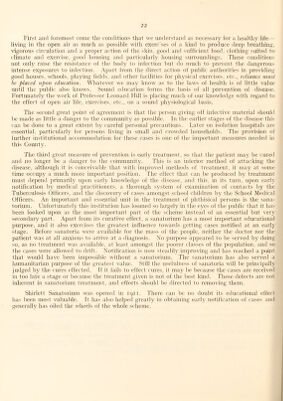
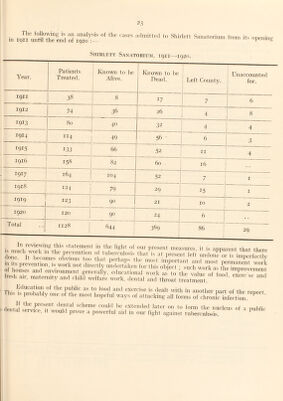
![I'irst iiiul foremost come the coirtlitions that we umlerstiuid as necessary for a healthy life— living in the open air as much as possible with exerc'ses of a kind to produce deep breathing, \'igorous circulation and a proper action of the skin, good and sufficient food, clothing suited to climate and exercise, good housing and particularly housing surroundings. These conditions not only raise the resistance of the boily to infection but do much to prevent the dangerous intense exposures to infection, .\part from the direct actioji of public authorities in prociding good houses, schools, playing fields, and other facilities for physical exercises, etc., reliance must he placed upon education. \\'hatever we may know as to the laws of health is of little value until the ])ublic also knows. Sound education forms the basis (jf all prevention of disease. Fortunately the work of Professor Leonard Hill is placing much of our knowledge with regard to the effect of o])en air life, exercises, etc., on a sound physiological basis. The second great point of agreement is that the persoai giving off infective material should be made as little a dangei to the community as possible. In the earlier stages of the disease this can be done to a great extejit by careful ])ersonal precautions. Later on isolation hospitals are essential, particularly for persons living in small and crowded households. The provision of further institutional accommodation for these cases is one of the important measures needed ni this County. The thiril great measure of prevention is early treatment, so that the patient may be curetl and jio longer be a danger to the community. This is an inferior method of attacking the disease, although it is conceivable that with impro\etl methods of treatment, it may at some time occupy a much more important position. The effect that can be produced by treatment must depend primarily upon early knowledge of the disease, and this, in its turn, upon early notification by medical practitioners, a thorough system of examination of contacts by the Tuberculosis Officers, and the discovery of cases amongst school children by the School Medical Officers. An importajit and essential unit in the treatment of phthisical persons is the sana¬ torium. Unfortunately this institution has loomed so largely in the eyes of the public that it has been looked upon as the most important part of the sdreme instead of an essential l)ut very secondary part. Apart from its curative effect, a sanatorium has a most important educational purpose, and it also exercises the greatest ijifluence towards getting cases notified at an early stage. Before sanatoria were available for the mass of the peo])le, neither the doctor nor the patient was at all anxiou^ to arrive at a diagnosis. Xo puqrose appeared to be served by doing so, as no treatmeait was available, at least amongst the poorer classes of the population, and so the cases wei'e allowed to drift. Xotification is now steadily improving and has reached a point that woukl have beeji impossible without a sanatorium. The sanatorium has also served a humanitarian purpose of the greatest value. Still the usefulness of sajuitoria will be principally jmlged by the cures effected. If it fails to effect cures, it may be because the cases are received in too late a stage or because the treatment given is not of the best kijul. These defects are not inherent in sanatorium treatment, and efforts should be directed to removing them. Shirlett Sanatorium was o])ened in 1911. There can be no doubt its educational effect has been most valuable. It has also hel])ed greatly in obtaining early notification of cases and gejverally has oiled the wheels of the whole .scheme.](https://iiif.wellcomecollection.org/image/b30086589_0036.jp2/full/800%2C/0/default.jpg)