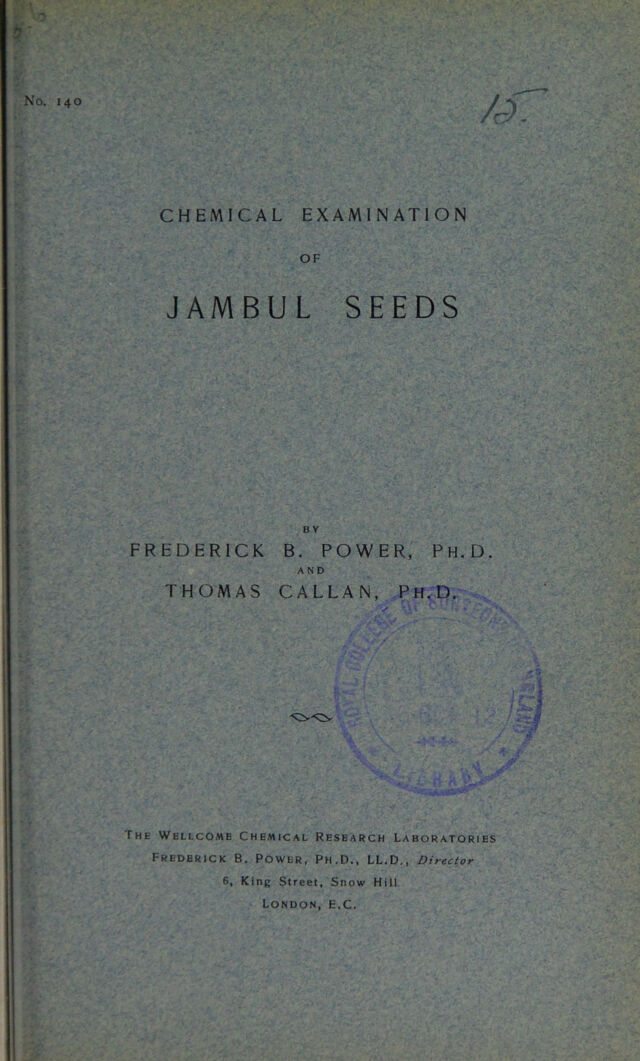
Chemical examination of jambul seeds / by Frederick B. Power and Thomas Callan.
- Frederick Belding Power
- Date:
- [1913]
Licence: In copyright
Credit: Chemical examination of jambul seeds / by Frederick B. Power and Thomas Callan. Source: Wellcome Collection.
Provider: This material has been provided by The Royal College of Surgeons of England. The original may be consulted at The Royal College of Surgeons of England.
7/18 page 3
![for which Gerrard proposed the name “ jambosin ” was not an acid, nor was it obtained from Jambul seeds, but from the roots of a plant which has somewhat doubtfully been re- ferred to Myrtus Jambosa, Linne (Jambosa vulgaris, DC.) (compare Pharm. Journ., 1884 [3], 14, 717). Another statement relating to Jambul seeds may briefly be considered. It has been claimed by Boersch that the active principle of these seeds is a crystalline glucoside, which was introduced into medicine under the names of “ antimellin ” or “ djoeatin ” (compare Apoth. Zeit., 1899, p. 510; 1900, p. 92; 1901, p. 350). The substance was said to have been obtained in yellowish needles, melting at about 182°, possessing a sweetish-bitter taste, and apparently having the formula, C,,Hjo07, but no analysis was recorded, nor has any further description of its characters been given. The clinical tests which have been made of this preparation by Hirschfeld (Apoth. Zeit., 1901, p. 42) proved it to have no influence on the excretion of sugar in diabetes. A liquid preparation was subsequently issued under the above names, which appears to have consisted of a decoction of Jambuil seeds [Apoth. Zeit., 1900, p. 92), with possibly other substances dissolved therein (Hager’s ‘ Handbuch,’ 1902, Bd. II., p. 1010). With consideration of the varying statements in the litera- ture of this subject, as indicated above, it seemed desirable to submit Jambul seeds to a further and more complete examination, and the results are embodied in the present communication. Experimental. The material employed for this investigation consisted of a quantity of authentic Jambul seeds, which had been obtained directly from India. Preliminary Tests. A small quantity of the powdered seeds was boiled with water, and the mixture filtered. The cold, aqueous liquid gave an intense blue colouration with iodine solution (showing the presence of starch) and a bluish-black colouration with ferric chloride (indicating the presence of tannin). Test for an Alkaloid.—Twenty grammes of the ground material were extracted with Prollius’ fluid, and the liquid so obtained subsequently examined in the usual manner for the presence of an alkaloid. The results were perfeotly nega- tive. B](https://iiif.wellcomecollection.org/image/b22439249_0007.jp2/full/800%2C/0/default.jpg)