Lectures on ectopic pregnancy and pelvic haematocele / by Lawson Tait, F.R.C.S., Edin., & Eng., LL.D.
- Lawson Tait
- Date:
- 1888
Licence: Public Domain Mark
Credit: Lectures on ectopic pregnancy and pelvic haematocele / by Lawson Tait, F.R.C.S., Edin., & Eng., LL.D. Source: Wellcome Collection.
Provider: This material has been provided by University of Bristol Library. The original may be consulted at University of Bristol Library.
115/122 (page 105)
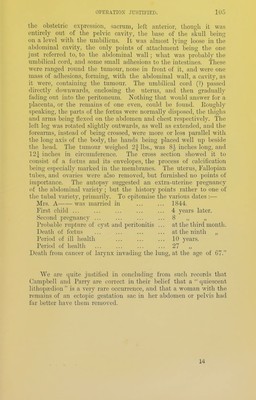
![OPERATION JUSTIFIED. lu;3 the obstetric expression, sacrum, loit anterior, though it was entirely out of the pelvic cavity, the base of tlie skull bein^' on a level with the umbilicus. It was almost lying loose in the abdominal cavity, the only points of attachment being the one just referred to, to the abdominal wall ; what was ])robably the umbilical cord, and some small adhesions to the intestines, these were ranged round the tumour, none in front of it, and were one mass of adhesions, forming, with the abdominal wall, a cavity, as it were, containing the tumour. The umbilical cord (?) passed directly downwards, enclosing tlie uterus, and then gradually fading out into the peritoneum. Nothing that would answer for a placenta, or the remains of one even, could be found. Eouglily speaking, the parts of the foetus were normally disposed, the thighs and arms being flexed on the abdomen and chest respectively. The left leg was rotated slightly outwards, as well as extended, and the forearms, instead of being crossed, were more or less parallel with the long axis of the body, the hands being placed well up beside the head. The tumour weighed 2| lbs., was 8i inches long, and 12\ inches in circumference. The cross section showed it to consist of a fcetus and its envelopes, the process of calcification being especially marked in the membranes. The uterus, Fallopian tubes, and ovaries were also removed, but furnished no points of importance. The autopsy suggested an extra-uterine pregnancy of the abdominal variety ; but the history points rather to one of tlie tubal variety, primarily. To epitomise the various dates :— Mrs. A was married in ... ... 1844. First child ... ... ... ... ... 4 years later. Second pregnancy ... ... ... ... 8 „ „ Probable rupture of cyst and peritonitis ... at the third month. Death of foitus ... ... ... ... at the ninth „ Period of ill health ... ... ... 10 years. Period of health 27 „ Death from cancer of larynx invading the lung, at the age of G7. We are quite justified in concluding from such records that Campbell and I'arry are correct in their belief that a quiescent lithopajdion is a very rare occurrence, and that a woman with the remains of an ectopic gestation sac in her abdomen or pelvis had far better have them removed. 14](https://iiif.wellcomecollection.org/image/b21448048_0115.jp2/full/800%2C/0/default.jpg)