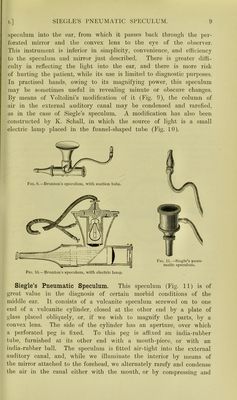
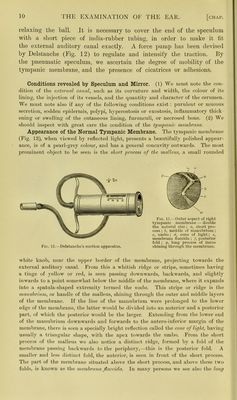
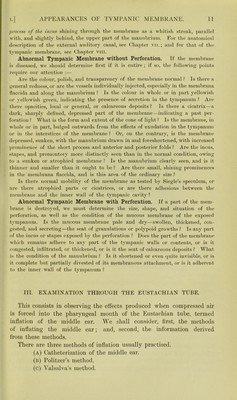
Manual of diseases of the ear : including those of the nose and throat in relation to the ear, for the use of students and practitioners of medicine / by Thomas Barr, M.D.
- Barr, Thomas, 1846-1916
- Date:
- 1901
Licence: In copyright
Credit: Manual of diseases of the ear : including those of the nose and throat in relation to the ear, for the use of students and practitioners of medicine / by Thomas Barr, M.D. Source: Wellcome Collection.
Provider: This material has been provided by The University of Glasgow Library. The original may be consulted at The University of Glasgow Library.
41/466 (page 13)
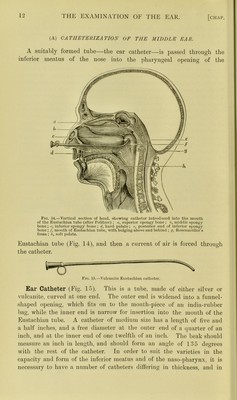
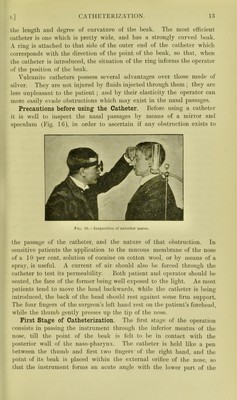
![>•] the length and degree of curvature of the beak. The most efficient catheter is one which is pretty wide, and has a strongly curved beak. A ring is attached to that side of the outer end of the catheter which corresponds with the direction of the point of the beak, so that, when the catheter is introduced, the situation of the ring informs the operator of the position of the beak. Vulcanite catheters possess several advantages over those made ol silver. They are not injured by fluids injected through them ; they are less unpleasant to the patient ; and by their elasticity the operator can more easily evade obstructions which may exist in the nasal passages. Precautions before using the Catheter. Before using a catheter it is well to inspect the nasal passages by means of a mirror and speculum (Fig. 16), in order to ascertain if any obstruction exists to Fig. 16. —Inspection of anterior nares. the passage of the catheter, and the nature of that obstruction. In sensitive patients the application to the mucous membrane of the nose of a 10 per cent, solution of cocaine on cotton wool, or by means of a spray, is useful. A current of air should also be forced through the catheter to test its permeability. Both patient and operator should be seated, the face of the former being well exposed to the light. As most patients tend to move the head backwards, while the catheter is being introduced, the back of the head should rest against some firm support. The four fingers of the surgeon’s left hand rest on the patient’s forehead, while the thumb gently presses up the tip of the nose. First Stage of Catheterization. The first stage of the operation consists in passing the instrument through the inferior meatus of the nose, till the point of the beak is felt to be in contact with the posterior wall of the naso-pharynx. The catheter is held like a pen between the thumb and first two fingers of the right hand, and the point of its beak is placed within the external orifice of the nose, so that the instrument forms an acute angle with the lower part of the](https://iiif.wellcomecollection.org/image/b24932553_0041.jp2/full/800%2C/0/default.jpg)