Manual of diseases of the ear : including those of the nose and throat in relation to the ear, for the use of students and practitioners of medicine / by Thomas Barr, M.D.
- Barr, Thomas, 1846-1916
- Date:
- 1901
Licence: In copyright
Credit: Manual of diseases of the ear : including those of the nose and throat in relation to the ear, for the use of students and practitioners of medicine / by Thomas Barr, M.D. Source: Wellcome Collection.
Provider: This material has been provided by The University of Glasgow Library. The original may be consulted at The University of Glasgow Library.
59/466 (page 31)
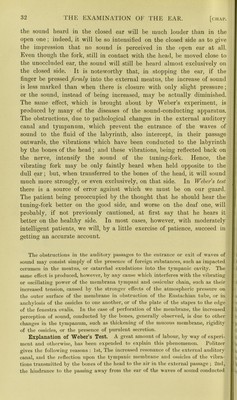
![I-] our purpose should be large-sized, and of the pitch C, with 512 vibrations in the second, fitted to produce a sound sufficiently long continued to ensure that the patient has time to recognize on which side he hears the sound best. It yields two simul- taneous sounds—the fundamen- tal or deep tone, and the high tones or harmonics. The har- monics are usually appreciated more distinctly when the fork is held some distance from the ear ; the fundamental tone pre- dominates when it is held nearer. The harmonics are in great measure destroyed, when the limbs of the tuning-fork are grasped by two brass clamps. When these are attached, only one tone is appreciated, and that one, on account of the number of vibrations per second being diminished, is much lower in the scale. By shifting the clamps towards the handle we render the pitch higher, until, when we reach the lower end of the limbs of the fork, it is raised a complete octave. In fig- si.—1Tuning-fork with A _ clamps. this way one tuning-fork, with the addition of these clamps, can produce a variety of notes according to the position of the clamps. Watch Test. In testing bone-conduction with the watch the ears should be closed by the patient’s fingers, and the watch applied first to the temple, and then to the mastoid process. The sound of even a loudly ticking watch may not be heard, when applied to the bones of the head, although the perceptive power of the auditory nerve is unimpaired ; but, if a weakly ticking watch is clearly heard, this indicates that the sentient part of the ear is pretty healthy. The usual methods of employing the tuning-fork are those of Weber and Rinne. Weber’s Test. Weber’s method is based upon the following experiment. If one ear be closed, and a sounding fork placed in contact with the middle line of the head, such as the bridge of the nose, the forehead, or the vertex, the effect will be very striking— Fig. 32.—Gardiner Brown’s tuning-fork.](https://iiif.wellcomecollection.org/image/b24932553_0059.jp2/full/800%2C/0/default.jpg)