First (-Second) report of the Royal Commission appointed to inquire into the subject of vaccination; with minutes of evidence and appendices.
- Great Britain. Royal Commission on Vaccination
- Date:
- 1889-1890
Licence: Public Domain Mark
Credit: First (-Second) report of the Royal Commission appointed to inquire into the subject of vaccination; with minutes of evidence and appendices. Source: Wellcome Collection.
Provider: This material has been provided by London School of Hygiene & Tropical Medicine Library & Archives Service. The original may be consulted at London School of Hygiene & Tropical Medicine Library & Archives Service.
192/520 (page 34)
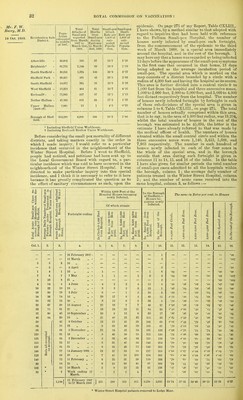
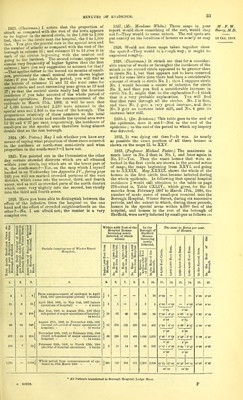
![Mr. F. W. This gives the special incidence for certain periods, Barry, M.D. I have divided the whole epidemic into six periods. The first period, from the commencement of the epi- 18 Oct. 1889. demic to April the 23rd, 1887, which may be called the pre-hospital period, is a period of two rannths, during which only four cases were admitted into hospital. The second period, from April the 23rd, 1887, to May the 21st, 1887, which may be called the period of minor operations of hospital, is a period of four weeks, during which 15 cases only were received. Then in a third period, from May the 21st, 1887, to August the 27th, 1887, which may be called the first sub-period of the hospital being in full use, there were 209 cases admitted, and there was an average daily number of small-pox cases in hospital of 41 ; and il is during that period that you see the incidence to be specially marked in the neighbourhood of the hospital, that being where it first shows itself. On reference to the table, columns 11, 12, 13, and 14, it will be seen that during that period in the first circle there was an incidence of 6 93 per cent., in the second circle it was 241 per cent., in the third circle • 86 per cent., and in the fourth circle '49 per cent. ; or, taking those to- gether, for the first two circles within 2,000 feet of the hospital it was 3'53 per cent, for these inner circles, as against 64 per cent, for the outer circles, whereas in the borough the incidence was only '19 per cent, of the houses. 1934. {Mr. Meadows White.) You do not include the hospital itself, I suppose ?—No. Then the fourth period is taken from August the 27th. 1887, to November the 19th, 1887, that is a period of 12 weeks. During that time 348 acute cases were admitted into the hospital, and there was an average daily number of 84 small-pox cases under treatment. During that period the inci- dence on the first circle was 7' 20 per cent, of the houses ; on the second 8' 17 per cent.; on the third 3' 88 per cent.; and on the fourth 2 ' 97 per cent.; or taking them in two circles of 2,000 feet each on the first 2,000 feet it was 7 ■ 92 per cent.; and on the second it was 3 • 30 per cent.; whereas the incidence in the rest of the borough was 1 • 07 per cent. During the fifth period, which is taken from November the 19th, 1887, to February the 25th, 1888, a period of 14 weeks, 514 cases were admitted to the hospital, and the hospital had a daily average of 84 cases under treatment. In this period the number of houses infected in the first circle were 5' 26 per cent.: in the second 6 • 62 per cent.; in the third 5 ■ 48 per cent.; and in the fourth 6' 27 per cent.; or, taking them as before in two circles, in the first 2,000 feet it was 6'28 per cent., and in the second 5 ■ 92 per cent.; whereas in the rest of the borough the rate was 4' 40 per cent.; still showing a very considerable excess of prevalence in the hospital area as against the rest of the borough. The last period that 1 was able to show was only for a short time of three weeks, after the hospital discontinued to receive patients. There were 54 actually admitted, but they were sent away to the borough hospital at Lodge Moor almost immediately after their admission, and there were practically no patients in the hospital. I think only one patient was left over until the end of the period. During this time the infections of houses fell at once ; in the first circle the rate was '17 per cent., in the second it was 32 per cent., in the third 24 per cent., and in the fourth 45 per cent. ; whereas in the rest of the borough it was 67 per cent, 1935. (Sir Edwin Galsworthy.) At that time how was the hospital supplied ? Was there free communication between the tradespeople 6f the neighbourhood and the hospital ?—You will find that an account of the regular and occasional visitors to the hospital is given in full on page 279 of my report. The tradesmen supplying the liospital delivered their goods at a side door of the administrative block, and none of them came necessa- rily into communication with ])atlent3 or with actual attendants on the sick, 1936. Then the tradespeople resided near the hos- pital, possibly ? —No, I should say not; in scarcely any case would the tradespeople reside near the hospital, because the hospital get s its goods from the town proper. 1937. {Professor Michael Foster.) Would they reside outside your last zone ?—I could not say that for cer- tain. The chief business part of the town is in the High vStreet and the Far Gate ; that is the division line between the south district and the west. i'JvjS. And some of it stretches, does it noty beyond your last circle ?—Yes; the business part of the town is most of it outside these circles altogether. 1939. {Dr. Collins.) Have we tiie dale at which the hospital -vf.'z closed for the admission of, small-pox pa- tients?—The 17th qf March iS; practically the date at which the hospital was closed, but at an antecedent date it had ip elJ'ect ceased operations. With regard to the earlier cases that occurred in this hospital area, I inquired into every case to ascertain whether there had been any direct communication with previoiis cases or with the. hospital, and I give an account of most of those at the bottom of pag^ 279. By comparing the first map, map, No. I., in the early part of my report with map No. II. and with the following maips, it will be at once seen hOiW the incidence of the earlier cases was transferred from the outside area to the inside after the oases, began to be removed to the hospital. Taking the first two months of the epidemic, ending April the 23rd, a period during which, as I have already stated, only four small-pox cases were treated in the Winter Street Hospital. 17 houses in the whole fciorough were infected, and only one of these was in the special area. You will see it| marked in map No. 11. That was a case where direct infection was p'robaLile. In the next four weeks, April 23rd to May-21st, already referred to as the period of minor operations of hos- pital, during which 15 cases were treated there, eight houses became infected, three of them in the sjiecial area. Those are shown in map No. III. : . 1940. {Mr. Meadows White.) These successive maps show new cases r—All new houses infected. 1941. But you do not show the old cases.as well?— —No, those are shown only as regards the first circle in the larger set of maps. 1942. {Dr. Bristowe) You do not show the number of cases but only the houses ?—Only the houses. 1943. Do you know at all the number of cases occur- ring in each circle?—I have a record of the nhmber of cases, but those are not given in the report. Taking map No. III., as regards two out of the three houses which were situated in the first and third zones, there was history of possible direct exposure of the first cases in the houses to antecedent small-pox. As regards the third house, as you will see from a larger map, map No. XXVIl., it was immediately in the rear of the hospital; and here no exposure of the first sufferer could be traced, and there was said to be no commu- nication whatever between the hospital and the inmates of that house. In the next map, map IV., which deals with the two weeks ending June the 4th. during which there was a daily average of 14 small-pox patients under treatment in the hospital, you will see that a considerable number of new houses were in- fected ; the figures are given in the last table but one that I have read. {See Question 1922, page 32.) In this fortnight, out of 20 houses newly infected in the borough, no less than 12 were situated in the special area. Of the 12, four were in the inner circle, two in the first zone, two in the second zone, and four in the third zone. In the case of two only out of the 12 could history be obtained of likely exposure of the person suffering small-pox to an antecedent case of the disease. As regards the other 10 no sort of personal communication with antecedent small-pox in the town or in the hospital at such time as would account for their attack could be discovered. In the larger maps you will see that I have always sl^iown the antecedent invasions by small-pox. The particular houses that became infected in any given fortnight are shown in red, whereas all the previously in- fected houses are shown in blue; so that an idea can be formed as to the inter-communication that might have taken place between one house and another. After June I did not attempt to trace infcciion in individual cases, the centres of infection being so numerous; more- over, it was so very long alter the commoiicemeut of the outbreak when I held the inquiry that this could not use- fully be done. Taking the whole epidemic, I have given a summary of the hospital incidence at the bottom of Dage 277, where I say : To sum up the whole period '' of hospital operations from the commencement of the epidemic in 1887 to March the 17th, 1888, the inci- deuce of small-pox on houses within the special area was nearly twice as great as on houses in the rest of the borough, and the incidence on the central circle and zone nearest the hospital was nearly twice as great as on the two outer zones of the special area.](https://iiif.wellcomecollection.org/image/b21361332_0192.jp2/full/800%2C/0/default.jpg)