A case of chronic lymphoid leukaemia with much temporary benefit from benzol treatment / by H.D. Rolleston and J.D. Rolleston.
- Humphry Rolleston
- Date:
- [1915?]
Licence: In copyright
Credit: A case of chronic lymphoid leukaemia with much temporary benefit from benzol treatment / by H.D. Rolleston and J.D. Rolleston. Source: Wellcome Collection.
3/12
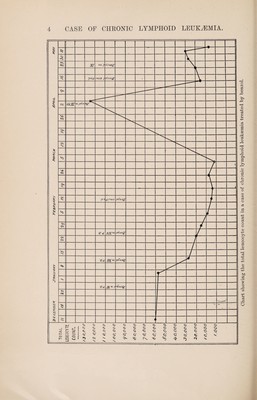
![Reprinted from ‘ The British Journal of Children’s Diseases,’ February, 1915, Vol. XII, pp. 33-39. A CASE OE CHRONIC LYMPHOID LEUKAEMIA WITH MUCH TEMPORARY BENEFIT FROM BENZOL TREAT¬ MENT* By H. D. Rolleston, M.D., F.R.C.P., and J. D. Rolleston, M.D. A boy, aged 6J years, was admitted on December the 11th, 1913, to the Victoria Hospital for Children, suffering from general debility and swelling in the neck of eight months* duration. Previous health.—-He had had measles twice, the second attack eight months before admission and followed by pneumonia. Other¬ wise he had been exceedingly healthy. The family history did not contain anything of importance. History of present illness.—Eight months ago, during his recovery from the second attack of measles, his mother noticed several lumps in his neck, these got progressively larger, but were never painful. On admission the patient was pale, anaemic, constipated, listless, and was obviously very ill. There were numerous hard enlarged painless glands in the cervical, parotid, submaxillary and occipital regions, axillae and groins. There was some dyspnoea, but x-ray examination of the mediastinum did not reveal any enlarged glands. The heart was slightly enlarged and a systolic apical murmur was present. The spleen was distinctly palpable on deep inspiration. The eyes were swollen and puffy, the forehead somewhat oedematous, and the superficial veins in that region dilated. Examination of the blood pointed to lymphoid leuktemia—large lymphocytes being in great excess. The total leukocyte count was then 60,000. On December the 29th, benzol treatment was commenced with an initial dose of D]vi per diem. On January the 10th it was increased to B]xii per diem, and on January the 25th to i)|xiv. This dose was continued until February the 12th, when the benzol was stopped altogether. The accompanying chart shows the progressive dimi- * The case was shown on two occasions at the Royal Society of Medicine, 1914, yip (Children’s Section), pp. 71, 129.](https://iiif.wellcomecollection.org/image/b30621306_0003.jp2/full/800%2C/0/default.jpg)