A case of chronic lymphoid leukaemia with much temporary benefit from benzol treatment / by H.D. Rolleston and J.D. Rolleston.
- Humphry Rolleston
- Date:
- [1915?]
Licence: In copyright
Credit: A case of chronic lymphoid leukaemia with much temporary benefit from benzol treatment / by H.D. Rolleston and J.D. Rolleston. Source: Wellcome Collection.
4/12 page 2
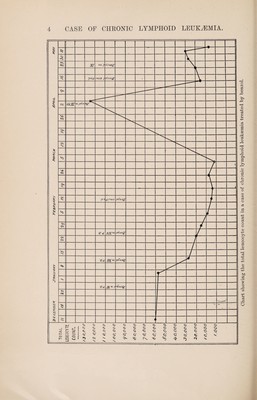
![nution in tlie total leucocyte count during the treatment. The patient’s general condition appeared to be greatly improved ; lassi¬ tude and weakness disappeared, his appetite improved, and the oedema of the head passed away. On the other hand the spleen remained practically unchanged in size, the glandular enlargement did not become less, and the patient did, not put on weight satisfactorily. After the benzol was omitted from the treatment the leucocyte count was still taken weekly and at one time was as low as 2900. About a week after the benzol had been stopped, a purpuric rash appeared on the forehead. As benzol poisoning causes purpura hsemorrhagica, this rash was regarded as a manifestation of mild benzol poisoning. On March the 4th, as the patient appeared to be extremely well and was running about the ward all day, he was transferred to the Con¬ valescent Home at Broadstairs. On April the 2nd he was re-admitted to hospital. The lymphatic glands were found to be distinctly harder and a trifle larger. The patient’s general condition was decidedly worse. He was exceedingly languid and very dyspnoeic. The total leucocyte count was 123,000, the small lymphocytes being the predominant cells present. Benzol npx per diem was again given, and in ten days’ time the count had fallen to 15,000. This marked decrease was also accompanied by an improvement in his general condition. On April the 16th, the benzol was again omitted, and on April the 20th, the leucocyte was found to be 20,000, and on April the 30th, 29,400. On May the 11th the child was put on benzol tt]xij per diem, but later in the day the temperature rose to 101*2° F.; the whole face became oedematous, with a purpuric rash on the right cheek and an offensive nasal discharge. A culture from the throat showed the presence of numerous diphtheria bacilli, and the child was therefore transferred on May the 13th to the Grove Hospital, Tooting, where 15,000 units of anti-diphtheritic serum were given. A smear from the mouth showed a very various flora, chiefly cocci, only a few fusiform bacilli and spirilla, not more than would be found in any infective condition of the mouth. No diphtheria bacilli were found in smears or cultures from-the mouth or nose. The condition of the face suggested cancrum oris, and, though the stomatitis improved •considerably under the local application of salvarsan, the child passed into a septicaemic state and died on May the 20th. Blood- examination by Dr. E. B. Gunson showed a well-marked leucopenia —1400 leucocytes on May the 14th and 1600 on May the 15th. At the autopsy on May the 21st there was no obvious enlargement of the submaxillary, cervical, tracheo-bronchial, or mesenteric](https://iiif.wellcomecollection.org/image/b30621306_0004.jp2/full/800%2C/0/default.jpg)