[Transactions of the American Ophthalmological Society] ; Transactions of the American Otological Society : second annual meeting, Newport, R.I., July, 1869.
- American Ophthalmological Society
- Date:
- [1869]
Licence: Public Domain Mark
Credit: [Transactions of the American Ophthalmological Society] ; Transactions of the American Otological Society : second annual meeting, Newport, R.I., July, 1869. Source: Wellcome Collection.
Provider: This material has been provided by The Royal College of Surgeons of England. The original may be consulted at The Royal College of Surgeons of England.
14/110 page 12
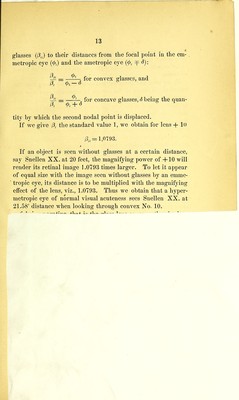
![n 12 tiff/ and in the same direction, namely, foricard if the sjfectades I are positive, and haclcicard if they are negative. J Let ns notv cotisider what injluence spectacles have on visual 1 acuteness. I Jly my own and Donders’ mcasurcinents wc know that the I radius of curvature of the cornea in ainetropic eyes does not I materially dilTer from that, in emmetropic eyes. With regard I to the curvature of the lens, only two measurements have been I made, one by Helmholtz and one by myself, on myoi)ic eyes. | l>oth eyes showed no diftercnce from the normal state. Similar I conditions may V)C assumed in tlie hyperopic eye. Therefore, I we may suppose that tlie optical constants of amctro{)ic eyes I ^ do not materially ditfer from tliose of •eminetro[)ic eyes. Tlie I j receding or advancing of the retina must be the cause of I ! ametropia, a fact which is well corroborated by anatomical 1 investigation. Since the retrocession or advancement depends I on a dilatation or contraction of the posterior portion of the I i globe, the retinal elements will stand closer together, or wider I apart, according to the degree of contraction or dilatation, and I a visual angle of the same size, and having its ajiex in the tirst I nodal point, will include about the same number of jiercijiient I retinal elements in the ainetropic as in the emmetrojiic eye. I By the addition of spectacles the tirst cardinal points do not I change, as we have seen, but the second are advanced by con- I , vex glasses, and moved liackward by concave glasses ; the 1 I visual angle, however, remains unchanged, as the axial ray is 1 only shifted on the ojitical axis parallel to its first direction. | The greatness of this shifting—that is, the displacement of the | I second nodal point on the axis—determines the enlargement or I = diminution of the retinal image belonging to one and the same | j object. Since the triangles formed by the retinal images and I their connecting lines with the second nodal point in its ]iri- ' I mary and secondary position arc similar, the dimensions of I j the retinal images are j^^'oportionate to their distances from the r i second nodal point. j: The distance of the posterior focal plane (retina in the s emmetropic eye) from the second nodal point being equal to > the first focal length of the eye (0,), wc obtain the following > relation of the retinal images without glasses (/3) and with [ ■■ V](https://iiif.wellcomecollection.org/image/b22449784_0018.jp2/full/800%2C/0/default.jpg)