[Transactions of the American Ophthalmological Society] ; Transactions of the American Otological Society : second annual meeting, Newport, R.I., July, 1869.
- American Ophthalmological Society
- Date:
- [1869]
Licence: Public Domain Mark
Credit: [Transactions of the American Ophthalmological Society] ; Transactions of the American Otological Society : second annual meeting, Newport, R.I., July, 1869. Source: Wellcome Collection.
Provider: This material has been provided by The Royal College of Surgeons of England. The original may be consulted at The Royal College of Surgeons of England.
20/110 page 18
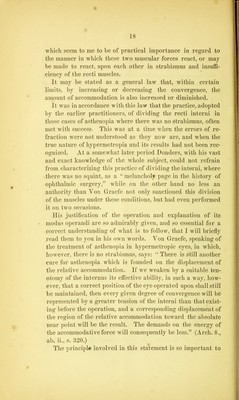
![which seem to me to be of practical importance in regard to the manner in which these two muscular forces react, or may be made to react, upon eacli other in strabismus and insuffi- ciency of the recti muscles. It may be stated as a general law that, within certain limits, by increasing or decreasing the convergence, the amount of accommodation is also increased or diminished. It was in accordance with this law that the practice, adopted by the earlier practitioners, of dividing the recti interni in those cases of asthenopia where there was no strabismus, often met witli success. This was at a time when the errors of re- fraction were not understood as they now are, and wlien tlie true nature of hypermetropia and its results liad not been rec- ognized. At a somewhat later period Donders, with his vast and exact knowledge of the whole subject, could not refrain from characterizing this practice of dividing the interni, where there was no squint, as a “melancholy page in the history of ophthalmic surgery,” while on the other hand no less an authority than Von Graefe not only sanctioned this division of the muscles under these conditions, but had even ])crformcd it on two occasions. His justification of the operation and explanation of its modus operandi are so admirably given, and so essential for a correct understanding of what is to follow, that I will briefly read them to you in his own words. A^on Graefe, speaking of the treatment of asthenopia in hypermetropic eyes, in which, however, there is no strabismus, says: “ There is still another cure for asthenojiia which is founded on the displacement of the relative accommodation. If we weaken liy a suitable ten- otomy of the internus its effective ability, in such a way, how- ever, that a correct position of the eye operated upon shall still be maintained, then every given degree of convergence will be represented by a greater tension of the interni than that exist- ing before the operation, and a corresponding displacement of the region of the relative accommodation toward the absolute near point will be the result. The demands on the energy of the accommodative force will consequently be less.” (Arch. 8., ab. ii., s. 320.) The principle involved in this statement is so important to](https://iiif.wellcomecollection.org/image/b22449784_0024.jp2/full/800%2C/0/default.jpg)