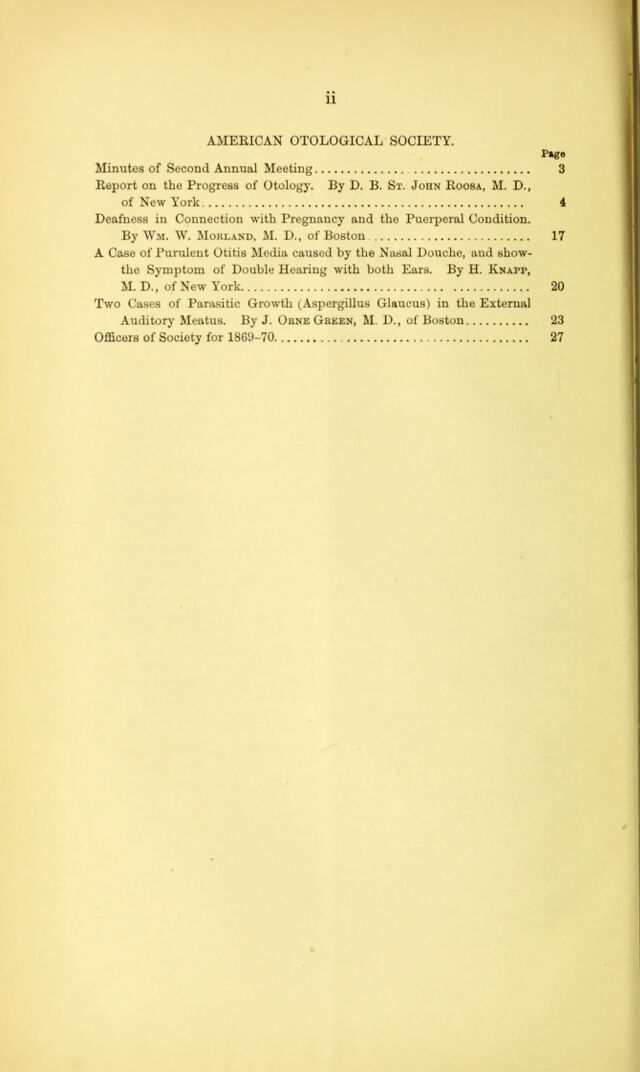
[Transactions of the American Ophthalmological Society] ; Transactions of the American Otological Society : second annual meeting, Newport, R.I., July, 1869.
- American Ophthalmological Society
- Date:
- [1869]
Licence: Public Domain Mark
Credit: [Transactions of the American Ophthalmological Society] ; Transactions of the American Otological Society : second annual meeting, Newport, R.I., July, 1869. Source: Wellcome Collection.
Provider: This material has been provided by The Royal College of Surgeons of England. The original may be consulted at The Royal College of Surgeons of England.
34/110 page 32
![tlie effect without paying much attention to tlic cause of the squint. The effect removed, we then attack tlie cause by taking into consideration the error in refraction, and Ave iwescribe glasses after one, two or three operations, as tlie case may be, not with the design that they may be of any independent value in themselves in removing or lessening the squint, for this has been done liy tkc operations, but simply to prevent a relajisc from that condition Avhich has been obtained perhaps from re- peated tenotomies. Most practitioners avoid ])utting on glasses till the Avound of the divided tendon is entirely healed, and then, surprised at the little effect gained, resort to another ojieration Avitliin a period of three or four Aveeks, or jierhaps even follow it Avitli a third. 1 have myself been in the habit of })rescribing glasses almost immediately after tlic operation; Init 1 have not been aware till lately Iioav important it Avas not to found the indication for them upon even an exact knowledge of tlie state of refraction gained before tlie operation, even by tlie aid of atropine, but upon data furnished oftrr the operation from a careful study of the state of the relative accommodation both for the far and near. I have seen just such rcsittts as those mentioned in the pre- ceding case folloAv, even Avhere no liinociilar vision existed, and 1 dare say there arc many more Avhieh Avill ultimately go the same Avay, the sight of Asdiich J shall be sjiared. Patients avIio have undergone the various vicissitudes from convergent to divergent squint have usually a disinclination to revisit the author of their Avoes, but there is none of us Avho does not from time to time get jiainful examples of each other’s failings. The popular fear so often expressed that the eye “may go the other Avay,” though gradually becoming less on account of im- proved methods of operating, is by no means extinct, cither in theory or point of fact. And although avc shall probably never be able to measure exactly the effect of a tenotomy, avc can at least do every thing in our poAver to come as near to it as pos- sy )le, and thus avoid disagreeable consequences, and one of the best Avays of doing this is, I believe, to treat more and operate less. To this effect 1 would suggest the propriety, in all cases of convergent squint in hypermetropic eyes, of reducing as far](https://iiif.wellcomecollection.org/image/b22449784_0038.jp2/full/800%2C/0/default.jpg)