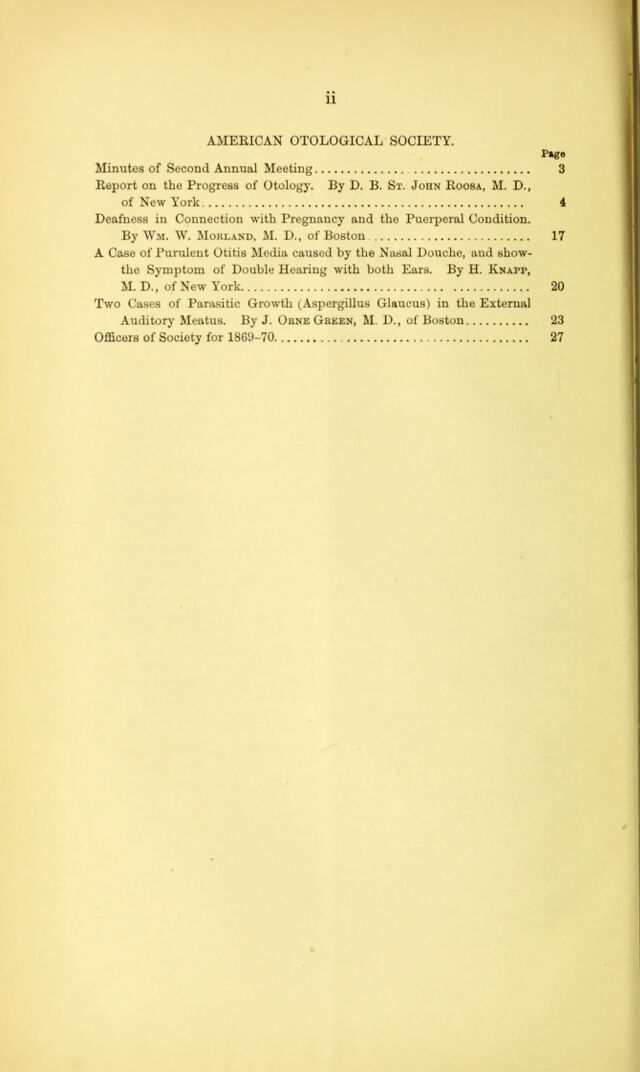
[Transactions of the American Ophthalmological Society] ; Transactions of the American Otological Society : second annual meeting, Newport, R.I., July, 1869.
- American Ophthalmological Society
- Date:
- [1869]
Licence: Public Domain Mark
Credit: [Transactions of the American Ophthalmological Society] ; Transactions of the American Otological Society : second annual meeting, Newport, R.I., July, 1869. Source: Wellcome Collection.
Provider: This material has been provided by The Royal College of Surgeons of England. The original may be consulted at The Royal College of Surgeons of England.
36/110 page 34
![these very })atients Iiave the power of carrying out the visual lines to parallel axes, as is sliown from the fact that their diplo- })ia is rarely if ever constant, while in some cases it is never, as it were, spontaneous, but can only be called forth by the colored g-lass. Why is it, then, that these patients, if they can overcome the intend to such a degree as to obtain parallel axes, cannot carry out tlie visual lines sulficient to allow them to read at a distance greater than 14, 12, or even 8 inches, as the case may be ? The explanation of this is, 1 think, to be found in the action of the accommodation, or rather in the associated action of the ciliary and the intend recti muscles. Under the tension of the ciliary muscle necessary to make reading ])0ssible, there is also a corresponding associated tension, on the interni, which has the tendency to turn the eye in, and which is counterbalanced in the normal eye by the opposing tension of the extend. If now for any given degree of con- vergence at whicli the ol)ject is held, the strain ])ut upon the extend in order to resist the interni, while accommodation is going on, is greater than they in their weakened condition can bear, they must of a necessity yield to the superior force; and the result is that the eyes are thus converged to a ])oint nearer than the ol)ject, which has to be gradually brought nearer and nearer till a j)oint is reached where the tension on the interni is so great that tlie extend, though reduced in jmwer, can re- sist it. But as soon as the accommodation necessary for dis- tinct vision for a near j)oint is relaxed, and with it the asso- ciated tension on the intend, the extend arc then able, freed from any opj)osing force, to carry the visual lines out till they l)ecomc parallel. Now although a high degree of convergence is necessary in these cases for close work, of course the tension on the interni is not so great for the same degree of convergence where the extend are weak as where they arc of normal strength. Thus we see that the relative accommodation may be displaced in- ward, even when the tension on the interni for every given de- gree of convergence is reduced. In emmetropia it is evident that this displacement inward of the field of accommodation can only take place, to any](https://iiif.wellcomecollection.org/image/b22449784_0040.jp2/full/800%2C/0/default.jpg)