Embryology, with the physiology of generation / trans. from the German, with notes, by William Baly.
- Johannes Peter Müller
- Date:
- 1848
Licence: Public Domain Mark
Credit: Embryology, with the physiology of generation / trans. from the German, with notes, by William Baly. Source: Wellcome Collection.
Provider: This material has been provided by The University of Leeds Library. The original may be consulted at The University of Leeds Library.
23/392 page 1423
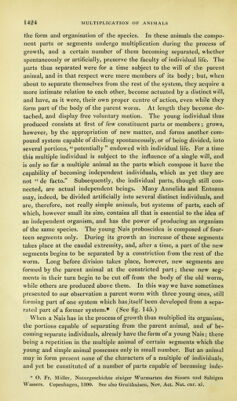
![tained in the leaves, though they exist also in the stem when stripped of its leaves. b. Animals. The power of multiplying the vital force resident in the germ is not peculiar to plants. Animals, and it would seem all animals without exception, possess the same property. There are many instances in the animal kingdom in which the multiplication of individuals in the process of growth is quite as distinct as in vegetables; but in other cases it can be proved to take place, only by induction from a series of facts. The young polype developed from the ovum or gemmule of a compound polypiferous animal is at first a single individual, actuated by a single independent will. But in proportion as this young creature ap- propriates to itself new matter and grows, it becomes transformed into a multiple system of individuals, like that presented by a full-grown plant, and is then evidently regulated in its movements by many distinct centres of volition. A common stem unites all the component simple animals, and in the Sertularia the cavity of this stem communicates with the cavity of each polype, while out of its wall new polypes sprout. Those compound polypes which consist of a mere aggregate of indepen- dent simple animals united into one mass, are not referred to in the foregoing description. One of the simple fresh-water polypes, or Hydrse, Fig. 144.* also, may, as we have learned from Trembley's ob- servations, be transformed in the process of growth into a system of individuals analogous to a plant, with the exception that in the case of the compound Hydra the elementary parts of the young polypes are not continued in an isolated manner through the trunk of the parent individual, and that the digestive sacs of all form part of one common cavity. Each of the individual polypes composing the compound Hydra [Fig. 144] is actuated by an independent will; may be separated from the rest; and is, in form at least, a perfectly simple animal. Thus far we have considered only those organisms which in their compound state, attained by growth, consist of a system of individuals not merely potentially, but (i actually ; the separate members of the compound system having each its proper structure and independent will. We now proceed a step further, and find animals which in form appear perfectly simple, and have only one directing will, but nevertheless are systems of parts endued with individual life, and capable of propagating * [Figure of a polype multiplying in the process of growth, after Trembley, M£- moires pour l'histoire des polypes pi. viii. fig. 7-1](https://iiif.wellcomecollection.org/image/b21522145_0023.jp2/full/800%2C/0/default.jpg)