The diseases of infancy and childhood : designed for the use of students and practitioners of medicine / by Henry Koplik.
- Henry Koplik
- Date:
- [1910]
Licence: Public Domain Mark
Credit: The diseases of infancy and childhood : designed for the use of students and practitioners of medicine / by Henry Koplik. Source: Wellcome Collection.
Provider: This material has been provided by the Augustus C. Long Health Sciences Library at Columbia University and Columbia University Libraries/Information Services, through the Medical Heritage Library. The original may be consulted at the the Augustus C. Long Health Sciences Library at Columbia University and Columbia University.
90/1030 page 80
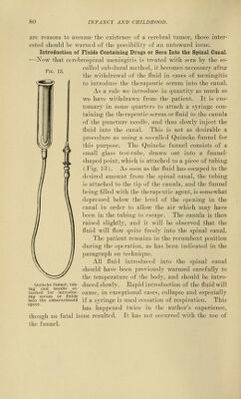
![Fig. 13. are reasons to assume the existence of a cerebral tumor, those inter- ested should be warned of the possibility of an untoward issue. Introduction of Fluids Containing Drugs or Sera Into the Spinal Canal. -—ISTow that cerebrospinal meningitis is treated with sera by the so- called sub-dural method, it becomes necessary aftar the withdrawal of the fluid in cases of meningitis to introduce the therajieutie serum into the canal. As a rule we introduce in quantity' as much as we have withdrawn from the patient. It is cus- tomary in some quarters to attach a syringe con- taining the therapeutic serum or fluid to the canula of the puncture needle, and thus slowly inject the fluid into the canal. This is not as desirable a procedure as using a so-calkd Quincke funnel for this purpose. The Quincke funnel consists of a small glass test-tube, drawn out into a funnel- shaped point, which is attached to a piece of tubing (Fig. 13). As soon as the fluid has escaped to the desired amount from the spinal canal, the tubing is attached to the tip of the canula, and the funnel being filled with the therapeutic agent, is somewhat depressed below the level of the opening in the canal in order to allow the air which may have been in the tubing to escape. The canula is then raised slightl}'', and it will be observed that the fluid will flow quite freely into the spinal canal. The 23atient remains in the recumbent position during the operation, as has been indicated in the paragraph on technique. All fluid introduced into the spinal canal should have been previously warmed carefully to the temperature of the body, and should be intro- duced slowly. Eapid introduction of the fluid will cause, in exceptional cases, collapse and especially This has ha])pened twice in the author's experience, though no fatal issue resulted. It has not occurred with the use of ihe funnel. QuiiiL-ke funnel, tub- ing ;m(l needle at- tachert for introduc- ing serum or fluids . . . » . . into the subarachnoid if a syriuge IS uscd ccssation of respiration space. ./ o](https://iiif.wellcomecollection.org/image/b21215947_0090.jp2/full/800%2C/0/default.jpg)


 No text description is available for this image
 No text description is available for this image
 No text description is available for this image