On the physical causes of the high rate of mortality in Liverpool : read before the Literary and Philosophical Society, in February and March, 1843 / by W.H. Duncan.
- William Henry Duncan
- Date:
- 1843
Licence: Public Domain Mark
Credit: On the physical causes of the high rate of mortality in Liverpool : read before the Literary and Philosophical Society, in February and March, 1843 / by W.H. Duncan. Source: Wellcome Collection.
Provider: This material has been provided by The Royal College of Surgeons of England. The original may be consulted at The Royal College of Surgeons of England.
51/76 page 51
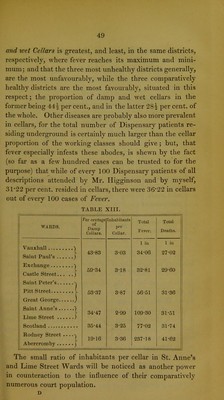
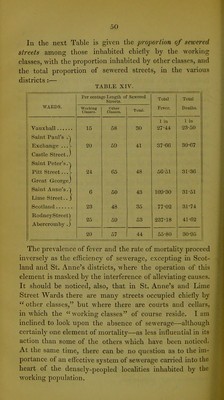
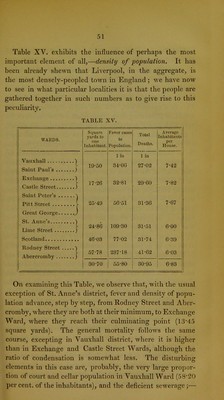
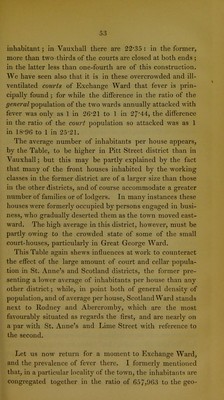
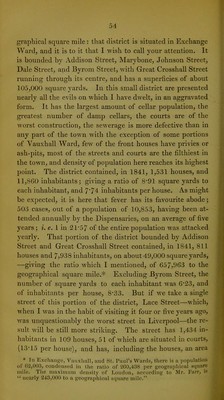
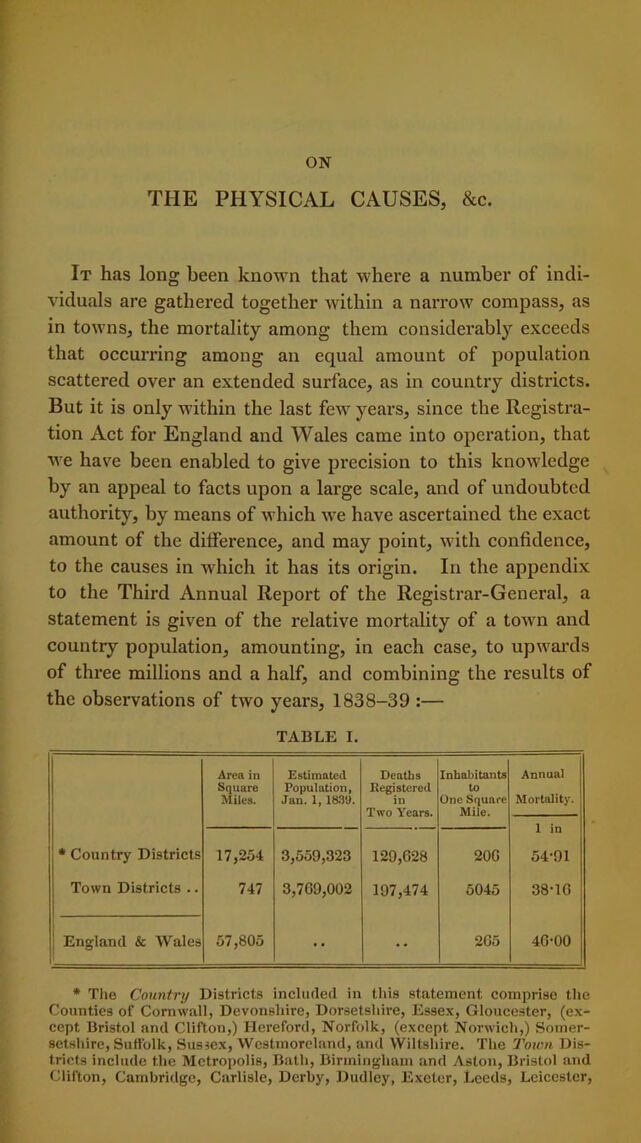
![Table XV. exhibits the influence of perhaps the most important element of all,—density of population. It has been already shewn that Liverpool, in the aggregate, is the most densely-peopled town in England ; we have now to see in what particular localities it is that the people are gathered together in such numbers as to give rise to this peculiarity. TABLE XV. WARDS. Square yards to one Inhabitant. Fever cases to Population. Total Deaths. Average Inhabitants per House. Vauxhall ] Saint Paul’s j 19-50 1 in 34-06 1 in 27*02 7-42 Exchange 1 Castle Street j Saint Peter’s \ 17-26 32-81 29-60 7-82 Pitt Street I 25-49 56-51 31-36 7-67 Great George ) St. Anne’s 1 Lime Street j 24-86 109-30 31-51 6-00 Scotland 46-03 77-02 31-74 6-39 Rodney Street 1 Abercromby j 57-78 237-18 41-62 6-03 30-70 55-80 30-95 6-83 On examining this Table, we observe that, with the usual exception of St. Anne’s district, fever and density of popu- lation advance, step by step, from Rodney Street and Aber- cromby, where they are both at their minimum, to Exchange Ward, w'here they reach their culminating point (13-45 square yards). The general mortality follows the same course, excepting in Vauxliall district, where it is higher than in Exchange and Castle Street Wards, although the ratio of condensation is somewhat less. The disturbing elements in this case are, probably, the very large propor- tion of court and cellar population in Vauxhall Ward (58-20 percent, of the inhabitants), and the deficient sewerage ;—](https://iiif.wellcomecollection.org/image/b22387341_0053.jp2/full/800%2C/0/default.jpg)
 No text description is available for this image
 No text description is available for this image
 No text description is available for this image