Observations on the physiology of the female genital organs, being a report to the Science Committee of the British Medical Association / by W. Blair Bell and Pantland Hick.
- William Blair-Bell
- Date:
- 1909
Licence: In copyright
Credit: Observations on the physiology of the female genital organs, being a report to the Science Committee of the British Medical Association / by W. Blair Bell and Pantland Hick. Source: Wellcome Collection.
Provider: This material has been provided by The Royal College of Surgeons of England. The original may be consulted at The Royal College of Surgeons of England.
16/76 page 16
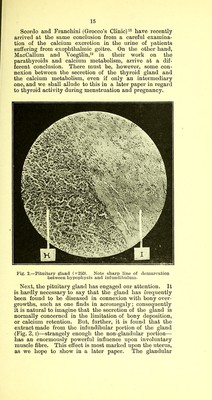
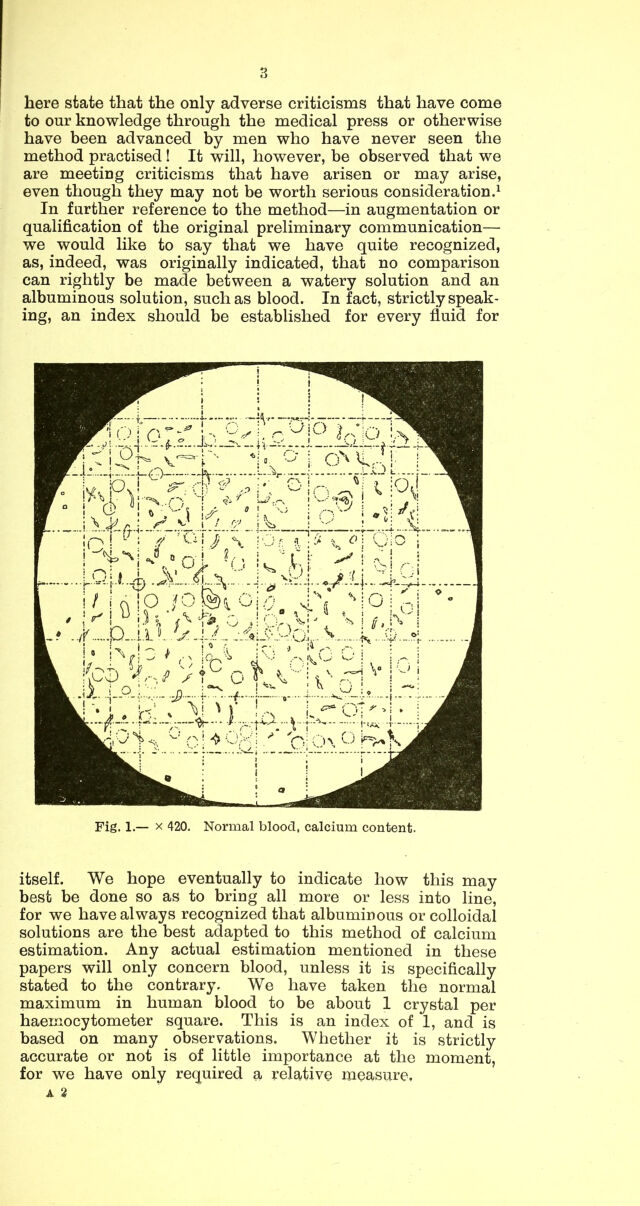
![portion of the gland (Fig. 2, h) is inactive in this respect. Mr. H. H. Dale, of the Wellcome Laboratories, who has kindly furnished us with the extract, has done much good work on this subject. Professor Schafer, however, was the first to remove the pituitary gland from the lumber room of “ embryonic relics.” We have reason to believe that further investigation will show that an intimate connexion exists between the pituitary extract and the calcium metabolism. Our experi- ments have been limited in number, but seem to show that under the influence of pituitary extract there is an increase of calcium in the blood, whether it is a normal or permanent effect we are not at the present moment prepared to say. Again, adrenal extract, as every one knows, has not only a marked influence on involuntary muscle, but also causes calcium retention in the tissues. Acting upon this knowlege, Bossi^^ of Genoa has found that osteomalacia can be much improved by the administration of this product, and experimentally it has been shown that calcareous retention in the blood vessels is brought about by its influence.*^ This, however, may be a natural process consequent upon an arteritis. Lastly, the ovaries (and testes possibly also) influence calcium metabolism, as is shown in many ways: osteo- malacia has been cured by oophorectomy, and we know that calcium retention occurs after the menopause. It is possible, also, that the part played by the internal secretion of the ovary in menstruation and pregnancy has reference to the calcium metabolism concerned in these processes. This syndrome of facts leads one to many speculations —speculations which must be checked by careful ex- perimentation. It seems, however, more than probable that the ductless glands preserve a balance in the calcium metabolism—as they do in many other metabolic processes—one acting anabolically, another katabolically. It is sufficient for our present purpose to know that there is some important relationship, but we hope in the subsequent papers to indicate and illustrate more fully the connexion that exists between these glands and the functions of the female genital apparatus. References. 1 See Correspondence, British Medicae Journal, March 14th, and 21st and April 4th, 1908. 2 The Biochemical Journal, vol. ii. No. 4. p. 387, 1907 [The methods used by Coleman, Wright, Brodie and Russell, and others, have been seriously questioned.—W. B. B., P. H.]. 3 q. T. Williams, The Etiology of Appendicitis, Liverjmol Mecl.-Chir. Journal, July, 1908. 4 Zibel, Munch, med. Woch., 1901, S. 1643 ; Gley and Richard, CoTnptes Bendus Soc. de Biol., 1903, Bd. 55, S. 464. 5 Boggs, Beut. Archivf. Min. Med , 1904, 79, xxix, S. 539 [The methods used by him have also been questioned.—W. B. B., P. H.]. 6 Rastre and Floresco, Archiv. de Physiol., 1896, S. 402. 7 Brat, Berl. Min. Woch., 1902, S. 1146 and 1170. ® Sackur, Grenzgehiete, 8, S. 188. 9 Morner, Zeit. f. Physiol. Chem., 1899, Bd. xxviii, p. 471. 7° C. J. Martin, A Communica- tion to the Physiol. Soc., Lister Institute, 1904. n Scordo and Franchini, II Policlinico, 1907, xvi, p. 285. ^2 MacCullum and Voegtlin, Johns HopMns Bulletin, March, 1908. ^3 Bossi, Zentralhl. f. Gyndlc., Nos, 3 and 6,1907, Wells, Chemical Pathology, p. 545, various references](https://iiif.wellcomecollection.org/image/b22466484_0018.jp2/full/800%2C/0/default.jpg)