Tuberculosis in childhood / by Dorothy Stopford Price ; with a chapter on tuberculous orthopaedic lesions and other contributions by Henry F. MacAuley.
- Price, Dorothy (Dorothy Stopford), 1890-
- Date:
- 1948
Licence: In copyright
Credit: Tuberculosis in childhood / by Dorothy Stopford Price ; with a chapter on tuberculous orthopaedic lesions and other contributions by Henry F. MacAuley. Source: Wellcome Collection.
18/294 page 4
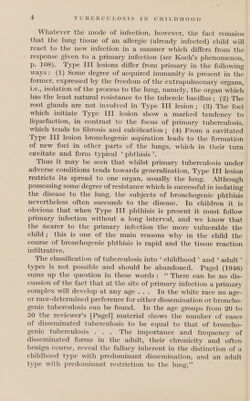
![Whatever the mode of infection, however, the fact remains that the lung tissue of an allergic (already infected) child will react to the new infection in a manner which differs from the response given to a primary infection (see Koch’s phenomenon, p. 108). Type III lesions differ from primary in the following ways: (1) Some degree of acquired immunity is present in the former, expressed by the freedom of the extrapulmonary organs, i.e., isolation of the process to the lung, namely, the organ which has the least natural resistance to the tubercle bacillus ; (2) The root glands are not involved in Type III lesion; (3) The foci which initiate Type III lesion show a marked tendency to liquefaction, in contrast to the focus of primary tuberculosis, which tends to fibrosis and calcification; (4) From a cavitated Type III lesion bronchogenic aspiration leads to the formation of new foci in other parts of the lungs, which in their turn cavitate and form typical ‘ phthisis’. Thus it may be seen that whilst primary tuberculosis under adverse conditions tends towards generalization, Type III lesion restricts its spread to one organ, usually the lung. Although possessing some degree of resistance which is successful in isolating the disease to the lung, the subjects of bronchogenic phthisis nevertheless often succumb to the disease. In children it is obvious that when Type III phthisis is present it must follow primary infection without a long interval, and we know that the nearer to the primary infection the more vulnerable the child; this is one of the main reasons why in the child the course of bronchogenic phthisis is rapid and the tissue reaction infiltrative. The classification of tuberculosis into ‘ childhood ’ and ‘ adult ’ types is not possible and should be abandoned. Pagel (1946) sums up the question in these words: ‘‘ There can be no dis- cussion of the fact that at the site of primary infection a primary complex will develop at any age... In the white race no age- or race-determined preference for either dissemination or broncho- genic tuberculosis can be found. In the age groups from 20 to 50 the reviewer’s [Pagel] material shows the number of cases of disseminated tuberculosis to be equal to that of broncho- genic tuberculosis . . . The importance and frequency of disseminated forms in the adult, their chronicity and often benign course, reveal the fallacy inherent in the distinction of a childhood type with predominant dissemination, and an adult type with predominant restriction to the lung.”](https://iiif.wellcomecollection.org/image/b32784636_0018.jp2/full/800%2C/0/default.jpg)