An introduction to medical literature, including a system of practical nosology : intended as a guide to students, and an assistant to practitioners. Together with detached essays, on the study of physic, on classification, on chemical affinities, on animal chemistry, on the blood, on the medical effects of climates, on the circulation, and on palpitation / by Thomas Young.
- Date:
- 1823
Licence: Public Domain Mark
Credit: An introduction to medical literature, including a system of practical nosology : intended as a guide to students, and an assistant to practitioners. Together with detached essays, on the study of physic, on classification, on chemical affinities, on animal chemistry, on the blood, on the medical effects of climates, on the circulation, and on palpitation / by Thomas Young. Source: Wellcome Collection.
Provider: This material has been provided by the Royal College of Physicians of Edinburgh. The original may be consulted at the Royal College of Physicians of Edinburgh.
594/700 page 560
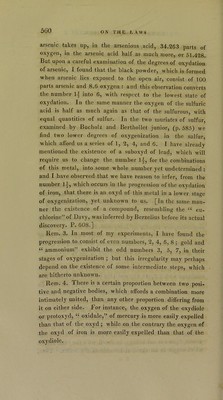
![arsenic takes up, in the arsenious acid, 34.263 parts of oxygen, in the arsenic acid half as much more, or 51.428. But upon a careful examination of the degrees of oxydation of arsenic, I found that the black powder, which is formed when arsenic lies exposed to the open air, consist of 100 parts arsenic and 8.6 oxygen : and this observation converts the number If into 6, with respect to the lowest state of oxydation. In the same manner the oxygen of the sulfuric acid is half as much again as that of the sulfurous, with equal quantities of sulfur. In the two muriates of sulfur, examined by Bucholz and Berthollet junior, (p. 585) we find two lower degrees of oxygenization in the sulfur, which afford us a series of 1, 2, 4, and 6. I have already mentioned the existence of a suboxyd of lead, which will require us to change the number If, for the combinations of this metal, into some whole number yet undetermined : and I have observed that we have reason to infer, from the number If, which occurs in the progression of the oxydation of iron, that there is an oxyd of this metal in a lower stage of oxygenization, yet unknown to us. [In the same man- ner the existence of a compound, resembling the “ eu- chlorine” of Davy, was inferred by Berzelius before its actual discovery. P. 608.] Rem. 3. In most of my experiments, I have found the progression to consist of even numbers, 2, 4, 6, 8 ; gold and <£ ammonium” exhibit the odd numbers 3, 5, 7, in their stages of oxygenization ; but this irregularity may perhaps depend on the existence of some intermediate steps, which are hitherto unknown. Rem. 4. There is a certain proportion between two posi- tive and negative bodies, which affords a combination more intimately united, than any other proportion differing from it on either side. For instance, the oxygen of the oxydiole or protoxyd, “ oxidule,” of mercury is more easily expelled than that of the oxyd ; while on the contrary the oxygen of the oxyd of iron is more easily expelled than that of the oxydiole.](https://iiif.wellcomecollection.org/image/b21915805_0594.jp2/full/800%2C/0/default.jpg)